

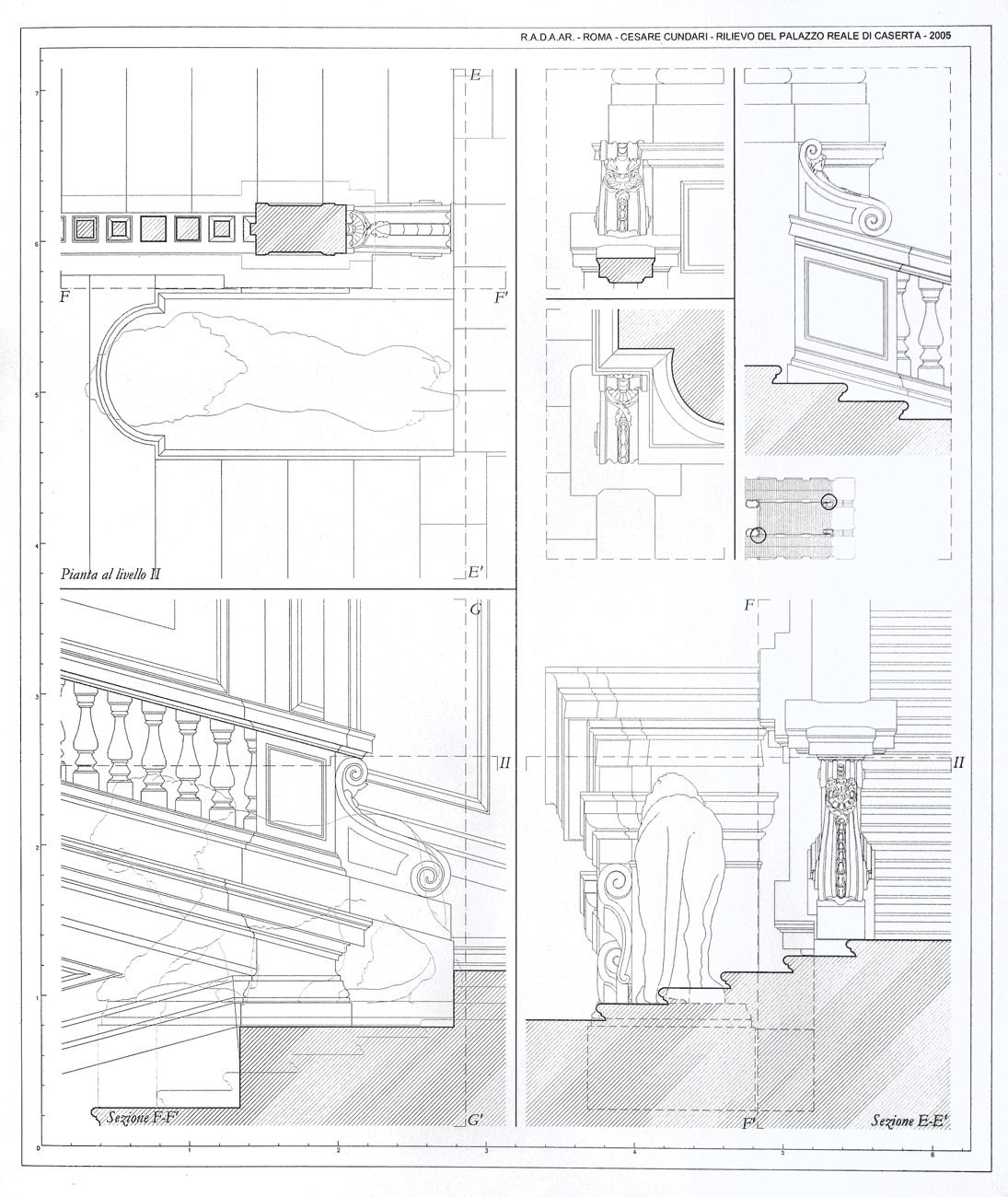
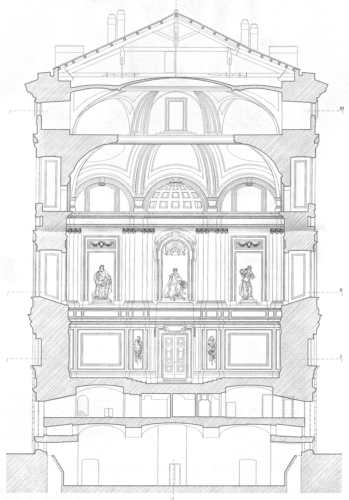
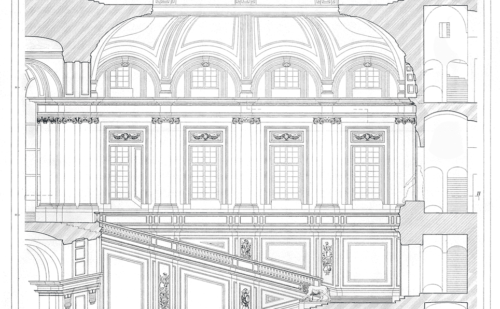
Rilievo dello Scalone nella zona del leone
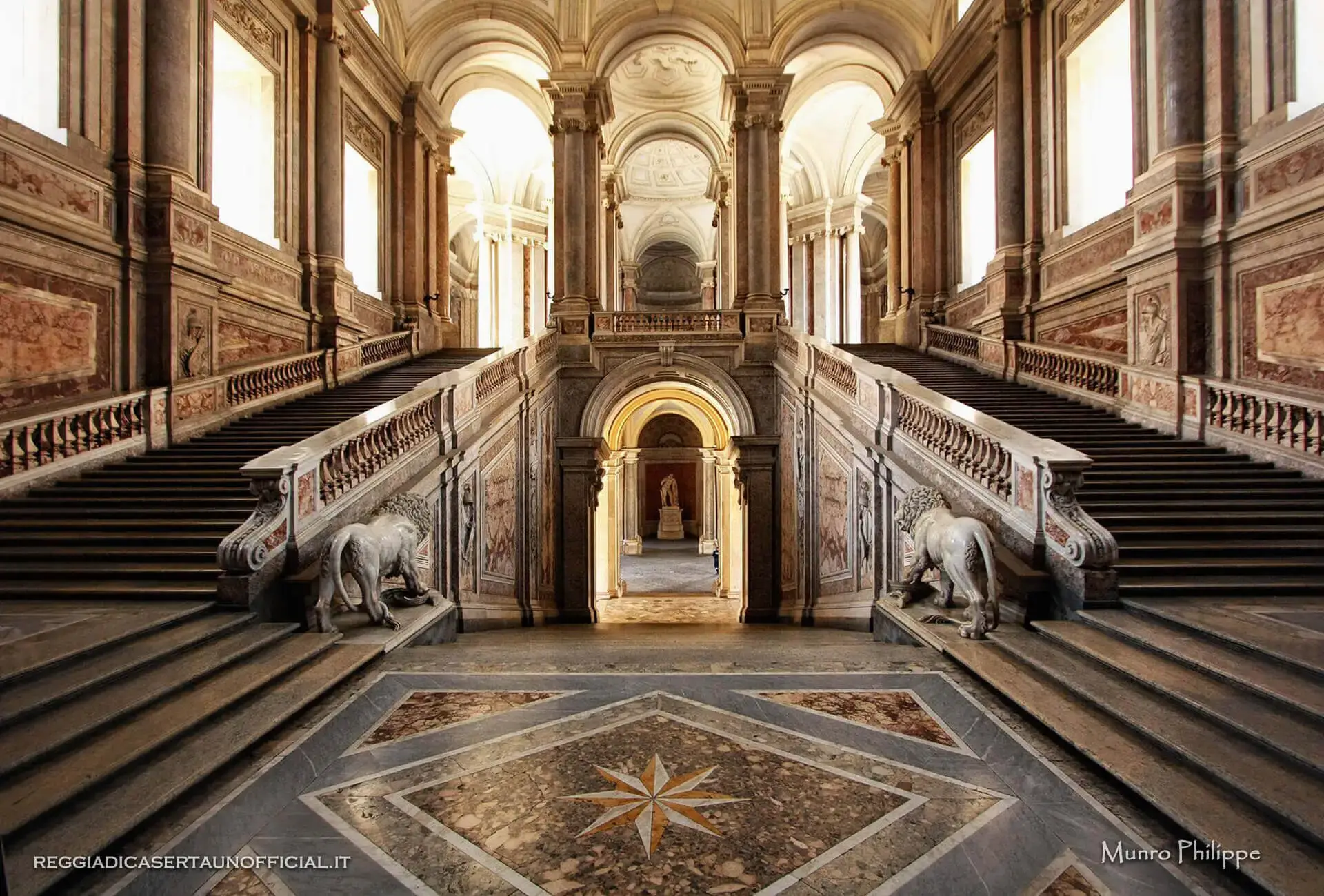
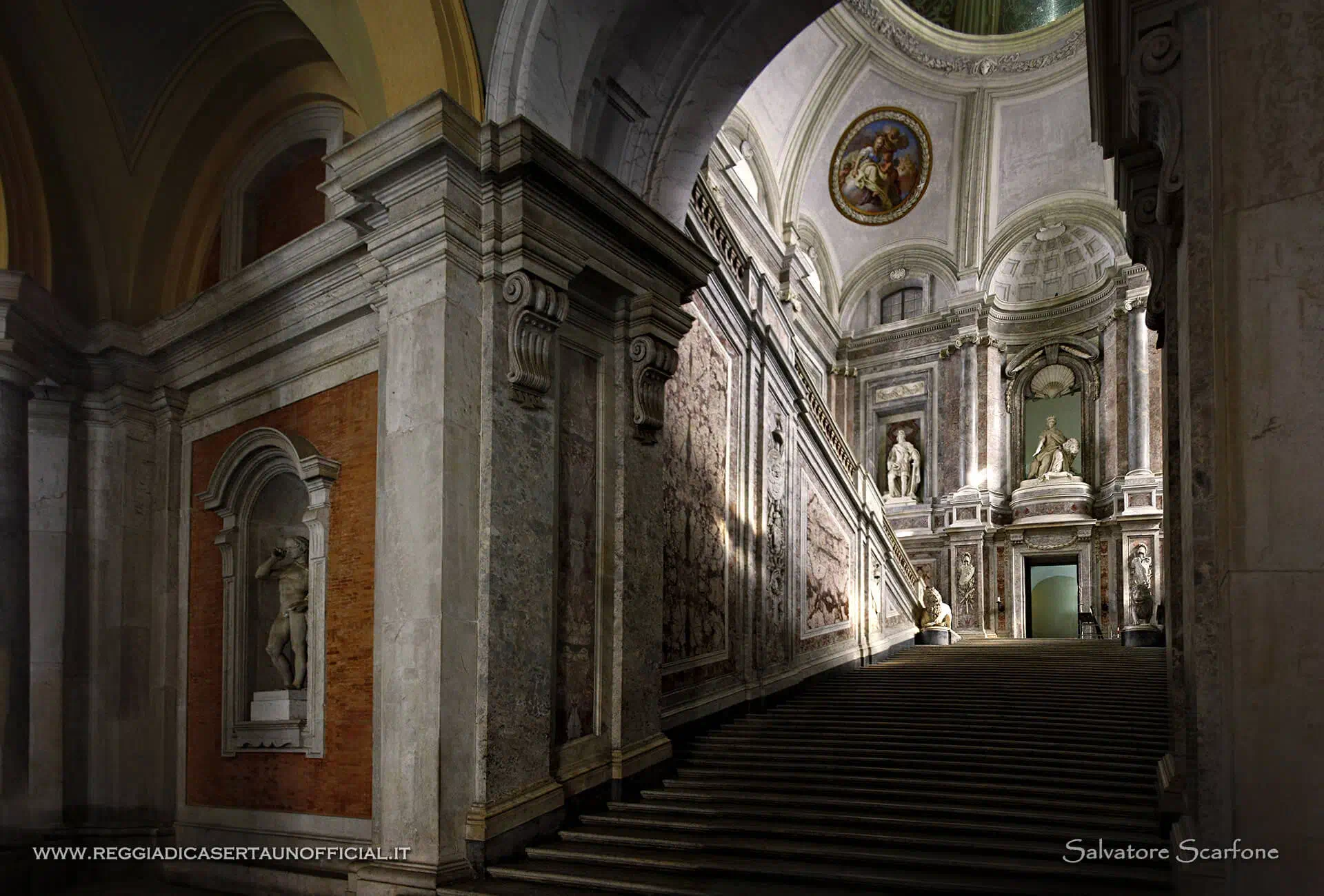
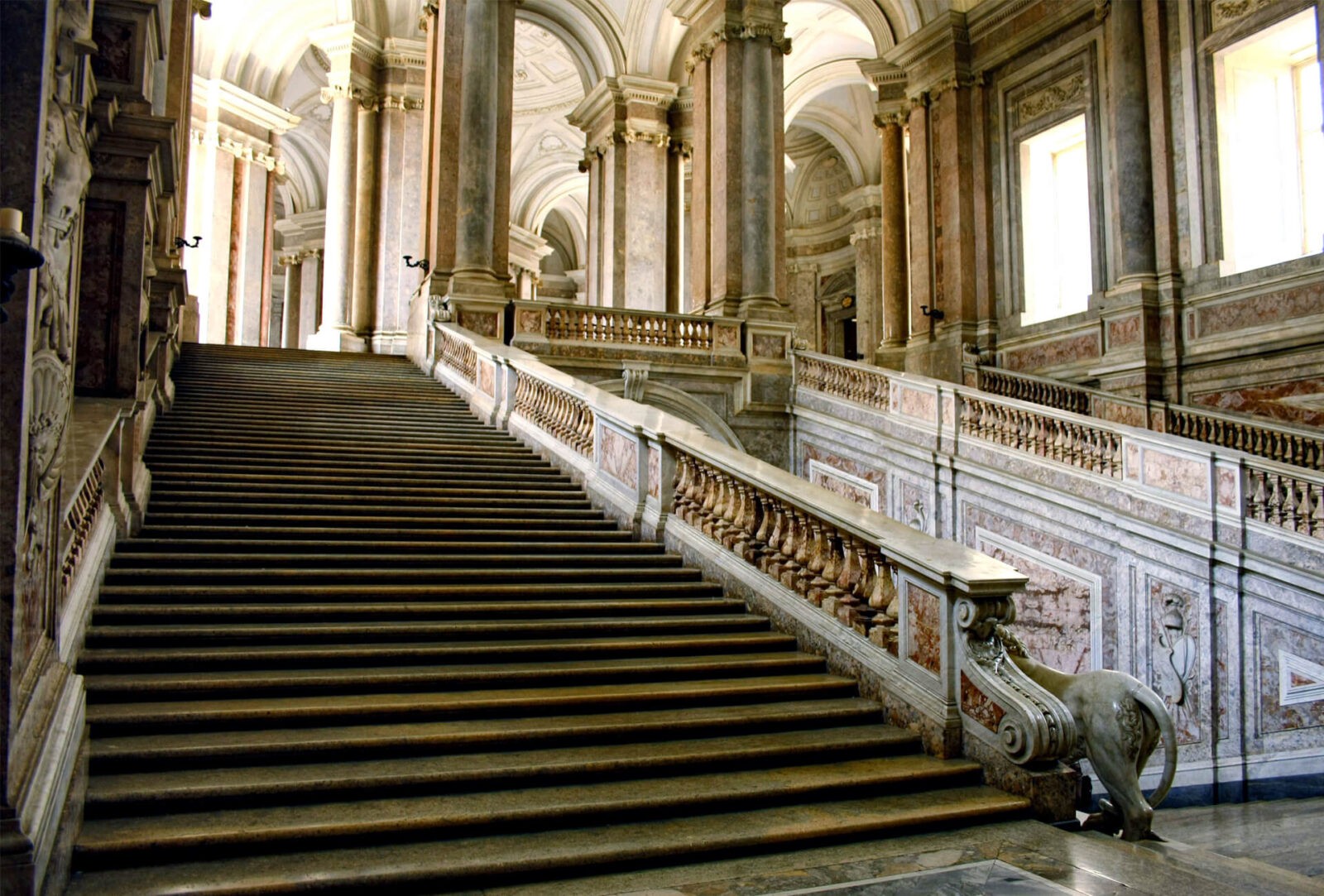
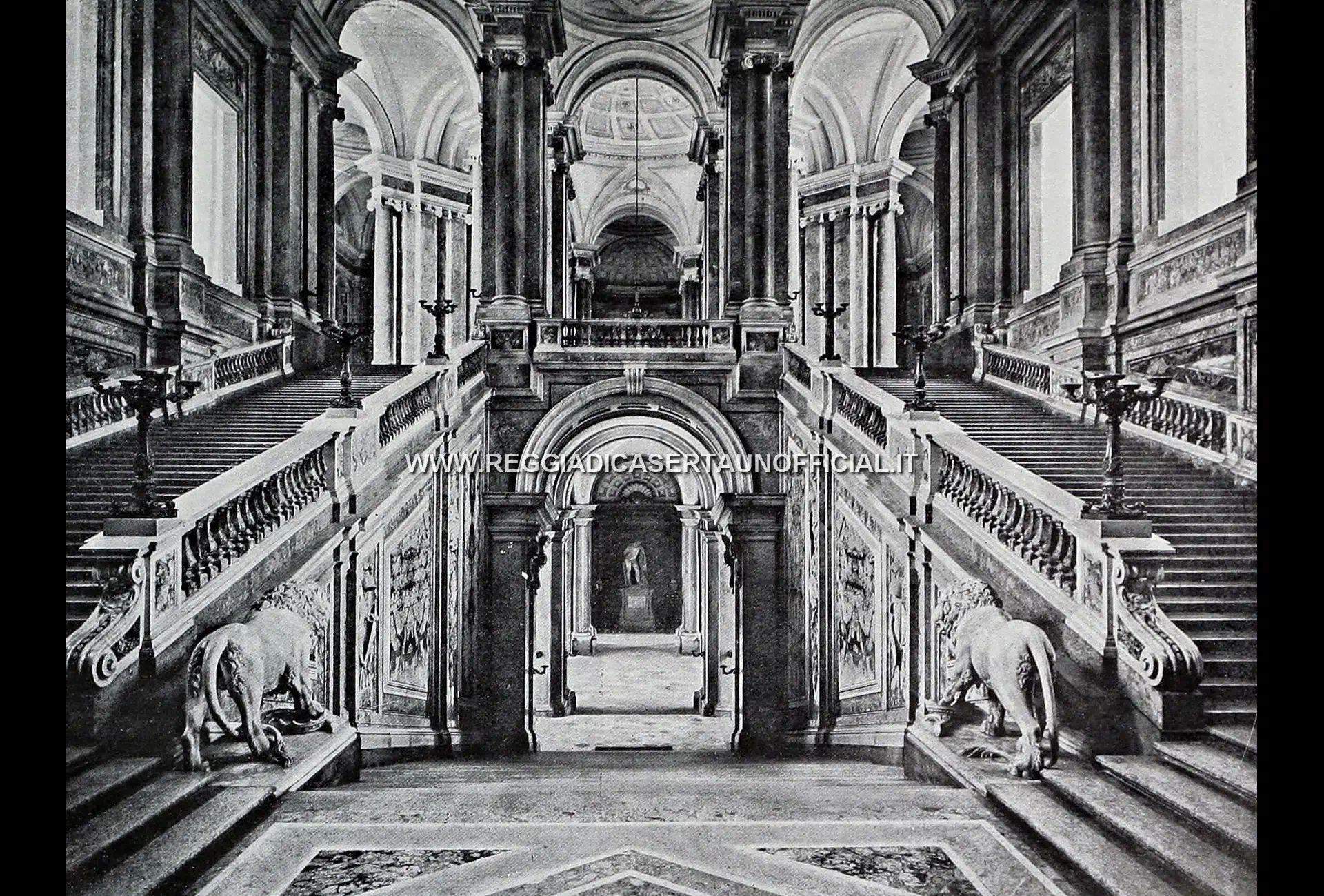
The upper rectangular balcony is dominated on the sides by two marble lions to signify, as can be deduced from the “Declaration of drawings “by Vanvitelli, the strength of reason and weapons that assure the king the “possession of his kingdoms”. The right lion is the work of Tommaso Solari while the one on left is by Paolo Persico. In addition to having a symbolic and decorative function, the lions also have an extremely practical function for Vanvitelli: if they weren’t there, climbing the staircase, one would notice the angle at the junction between the wall and the upper balustrade of the second staircase, canceling the much sought-after surprise effect.
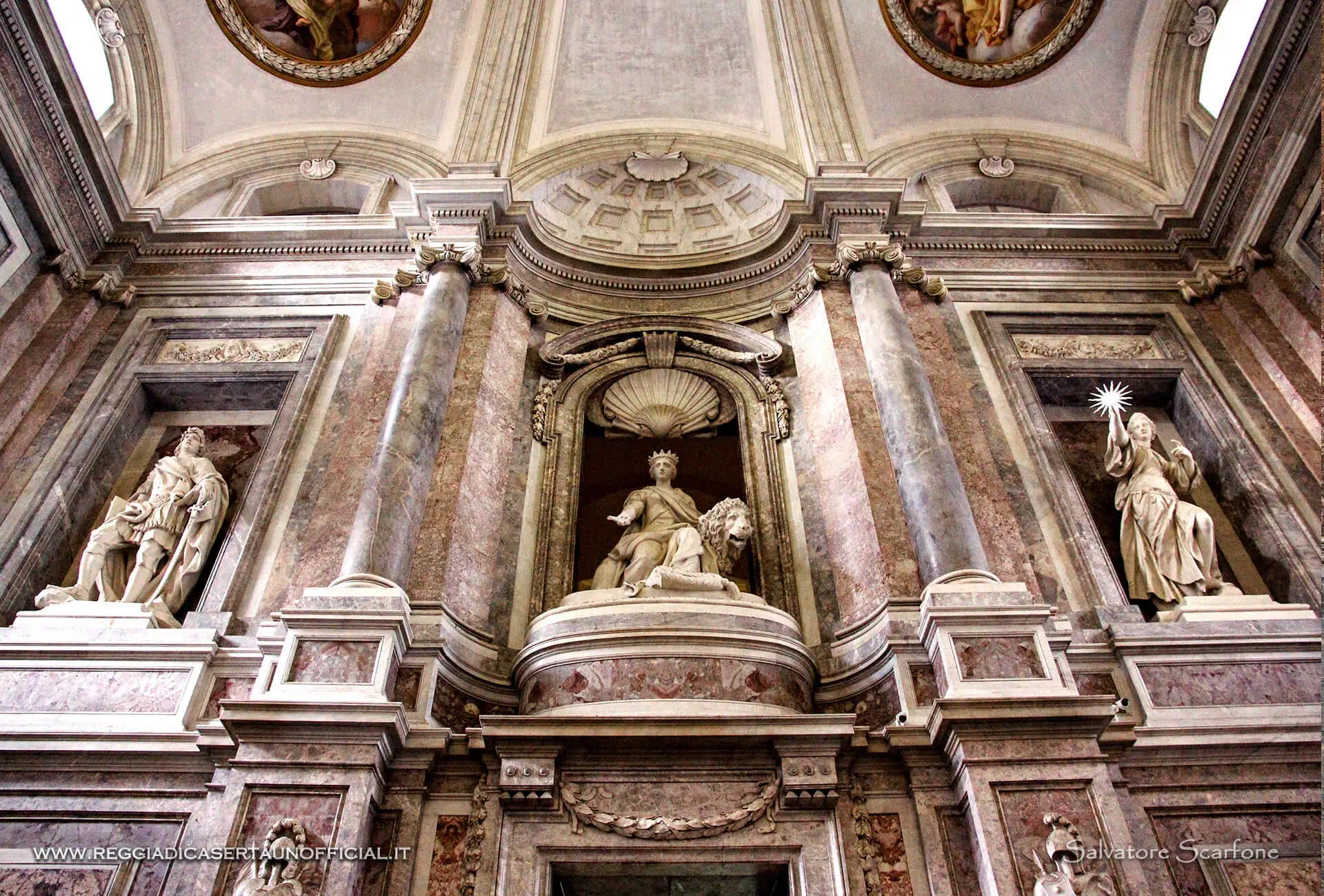
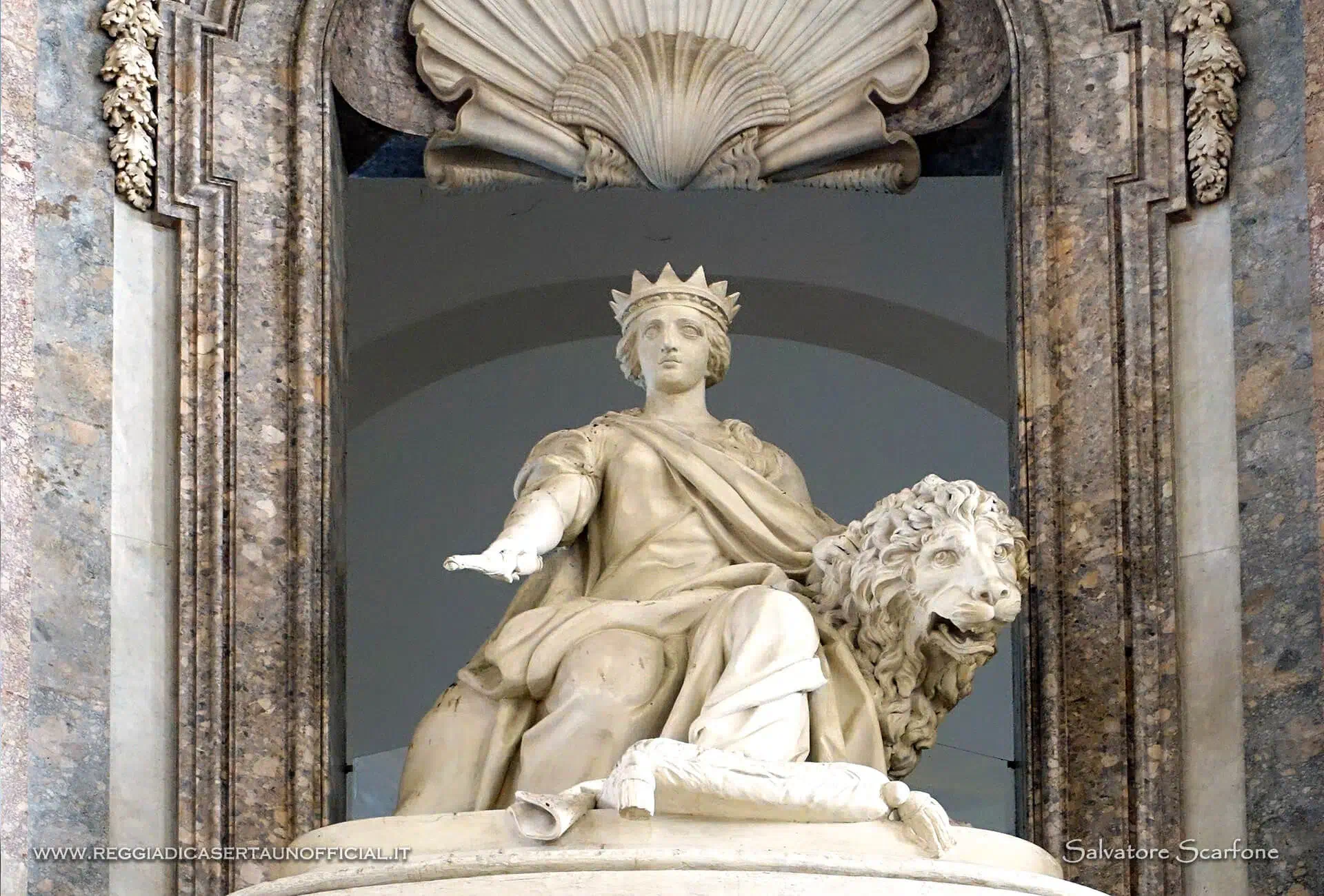
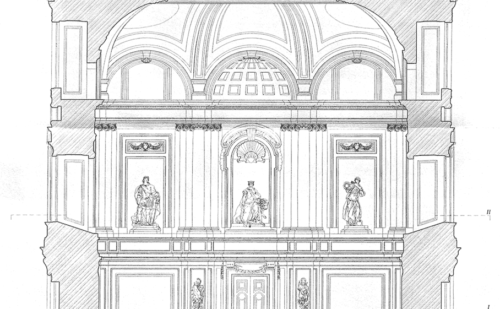
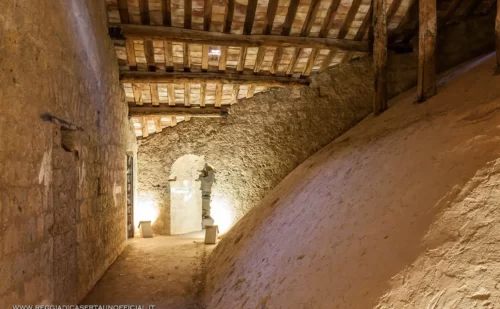
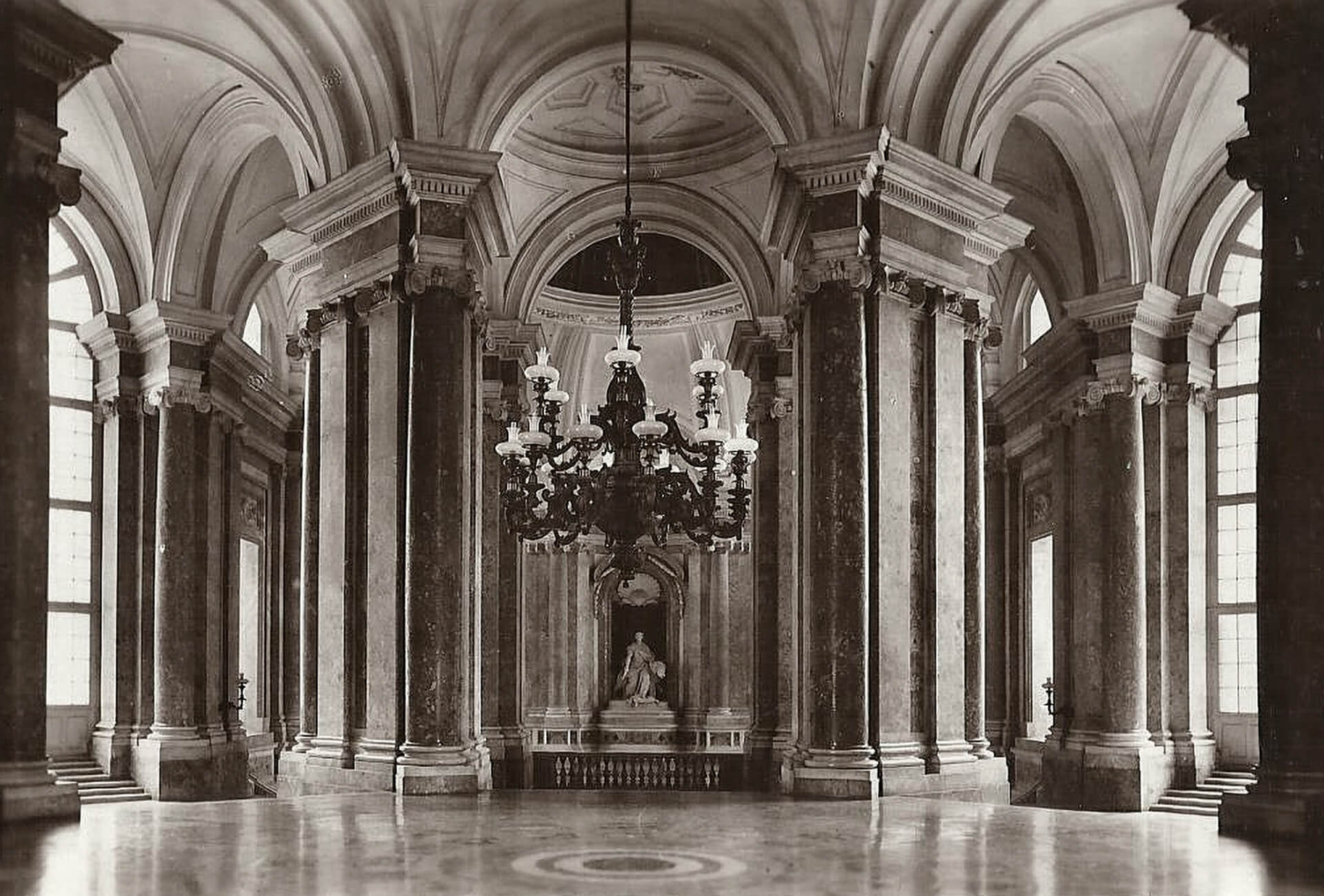
At the end of the Grand Staircase we find the immense back wall. It is divided into three main sections dominated by three huge sculptures surrounded by frames, and above by three arched elements, two of which have false painted windows, and in the center by a coffered semi-dome. Below the central statue there is a large door flanked by two semi-pillars decorated with bas-relief trophies. Observing the central statue, it is possible to notice behind it the presence of a room from which, through a circular ramp, the musicians climbed to the top of the vault of the Grand Staircase.
This is the only time Vanvitelli allows the gaze to move freely, while usually in the Grand Staircase every single movement of our gaze is not spontaneous, but skilfully calculated by the architect. This does not happen in other large European staircases such as, for example, the one in Palazzo Bianco in Genoa and in the Würzburg Palace, where the decorative abundance and the shape of the ramps disperse our attention.
We could also add that, probably, Vanvitelli inserted the space behind the Maestà Regia to distract us for a moment from continuing the climb, as this further increases the surprise effect by turning around.
Relief of the facade with the three statues of the Grand Staircase
The three enormous statues were commissioned by Vanvitelli to intimidate visitors during the ascent. Let’s read his words extracted from the Declaration of drawings of the Reggia of Caserta (adapted):
Among the many subjects that can be adapted to this project, these three were chosen because they seemed the most suitable. There are two main reasons why subjects usually ask for an audience with the king: one is to ask for protection, the other is to claim positions. But as among those who go to complain sometimes there are also slanderers, such as those who have blatant claims, so to keep them away from the ears of the Prince, from the very beginning of the ladder they are warned not to come here to defame anyone, nor let him come and demand something if he himself has no merit, because the Majesty of the King, just judge of truth and merit, will not let himself be enchanted by them.
Vanvitelli’s original project envisaged an inscription under each statue, later not added.






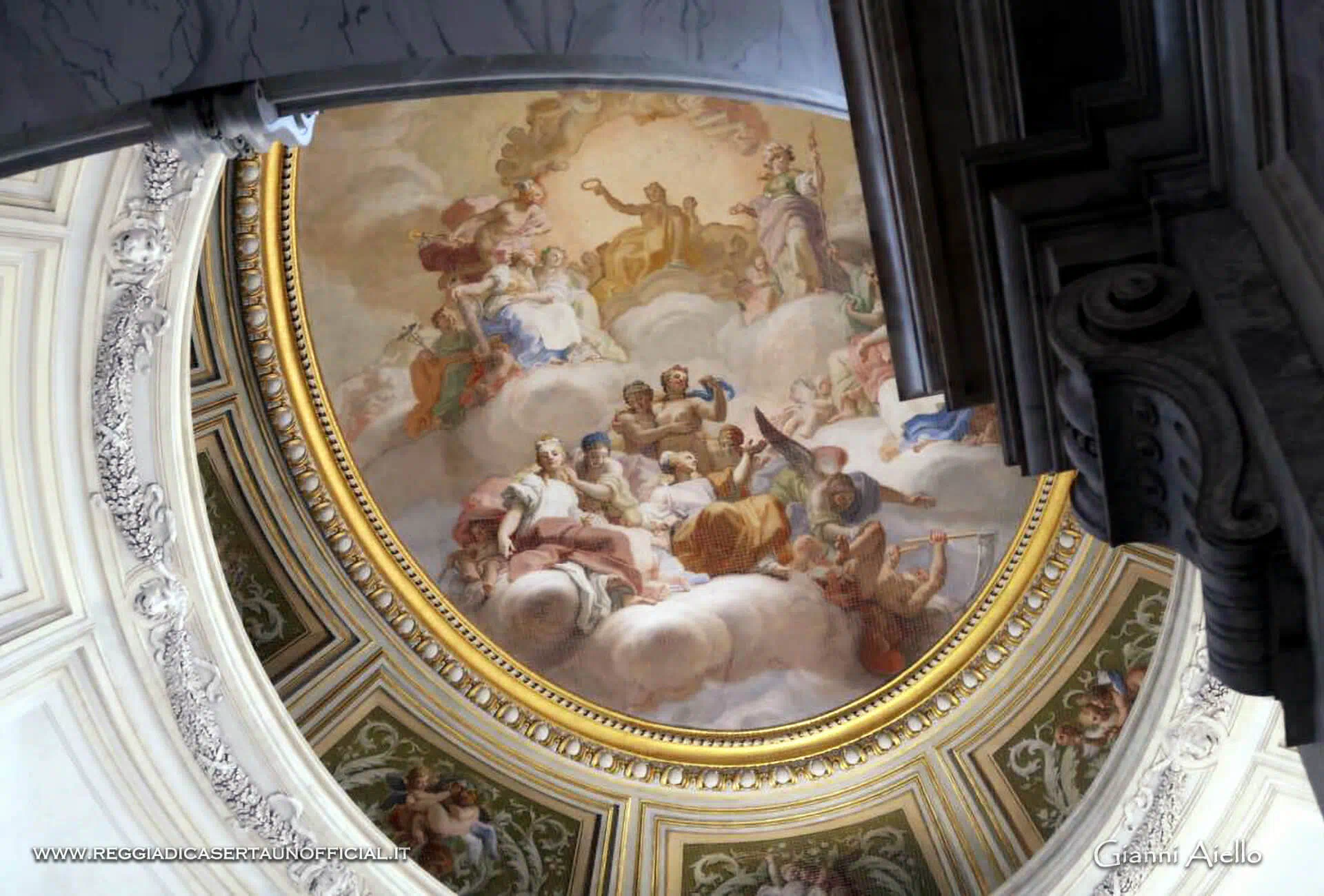
- allowed you to better divide the interior space;
- allowed you to increase the height and thus make it visible from afar until it became a symbol;
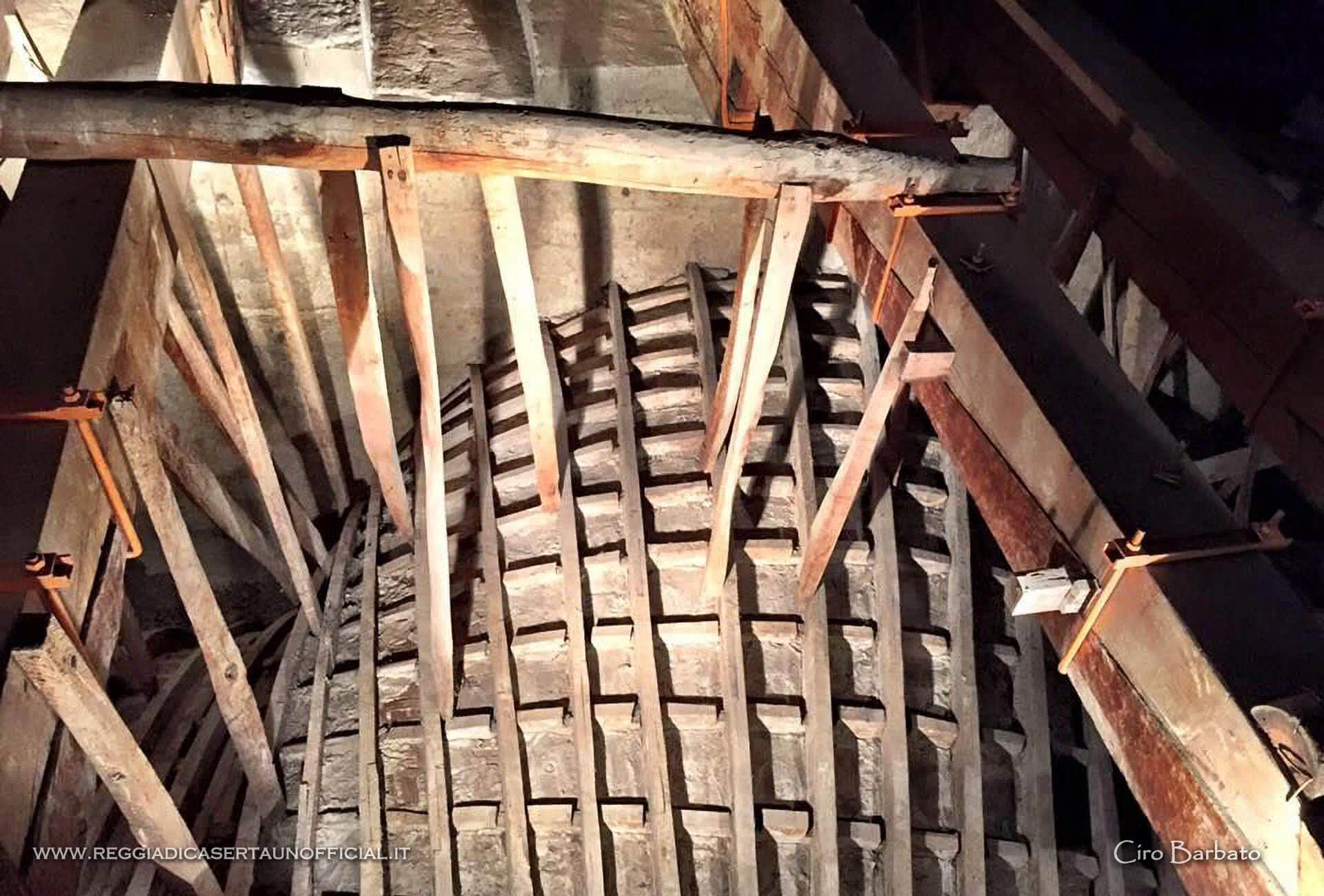
- the gap between the two domes made it possible to hide the internal structures that support the domes.
-

- Lo schema progettuale della cupola




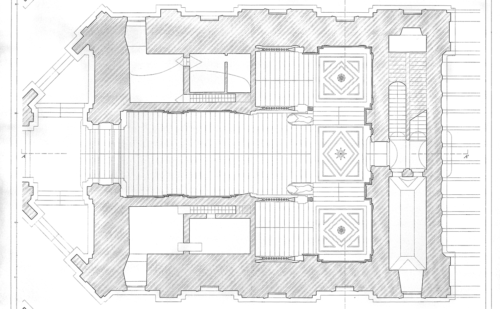
Dimensions of the Grand Staircase
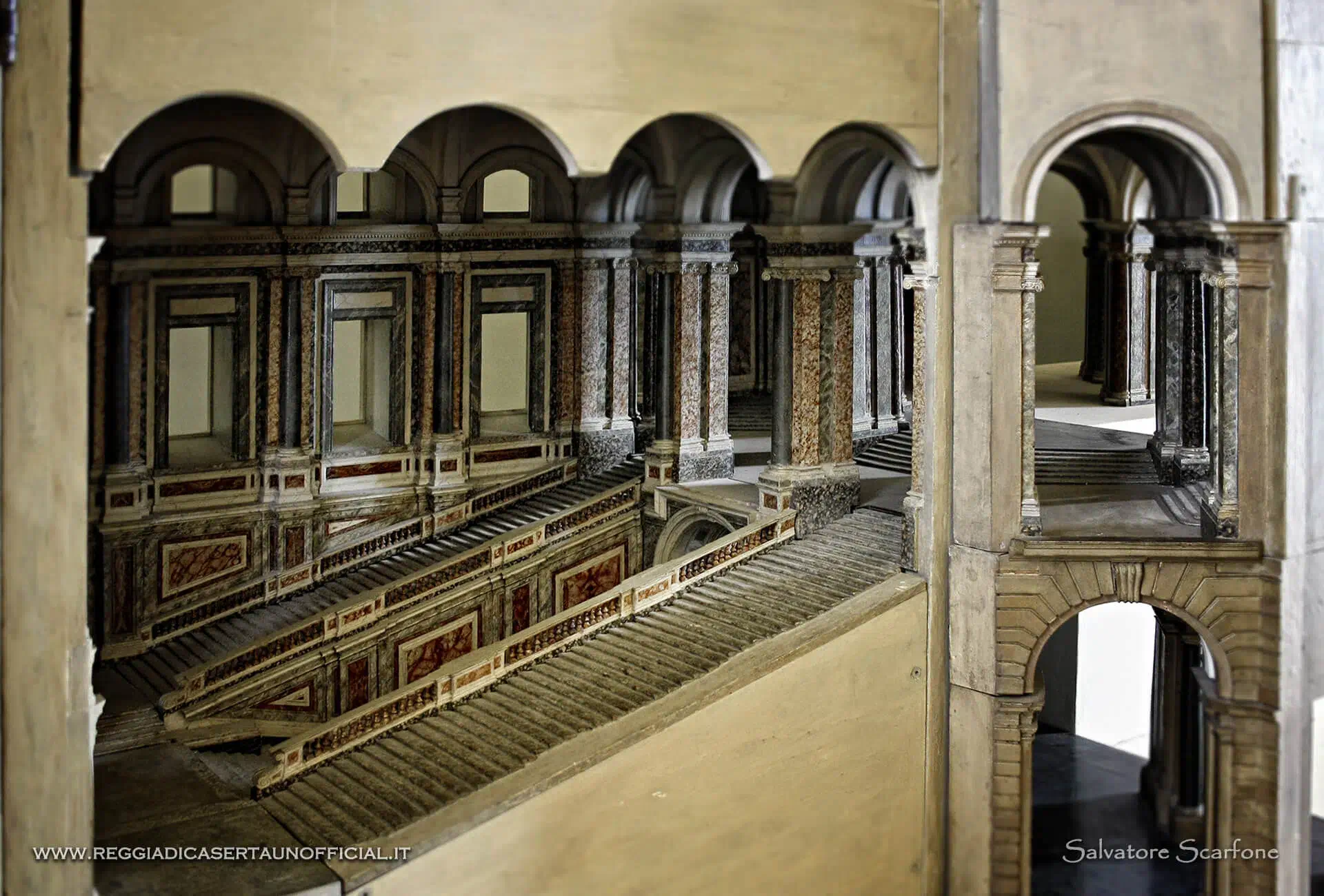
Wooden model of the Grand Staircase made by Antonio Rosz
(to be understood as minimal)
- 18x24m (lxp excluding window depth)
- Height at first dome level: 27m
- Height at second dome level: 32m
- Height at the level of the structures supporting the dome: 38m
- Width of the stairs: central 8m, lateral 5m each
- Total volume excluding upper vestibule at first dome level: 11.664m3
- Upper vestibule: 27x27m
-
- Rilievo della facciata con le tre statue dello Scalone
-
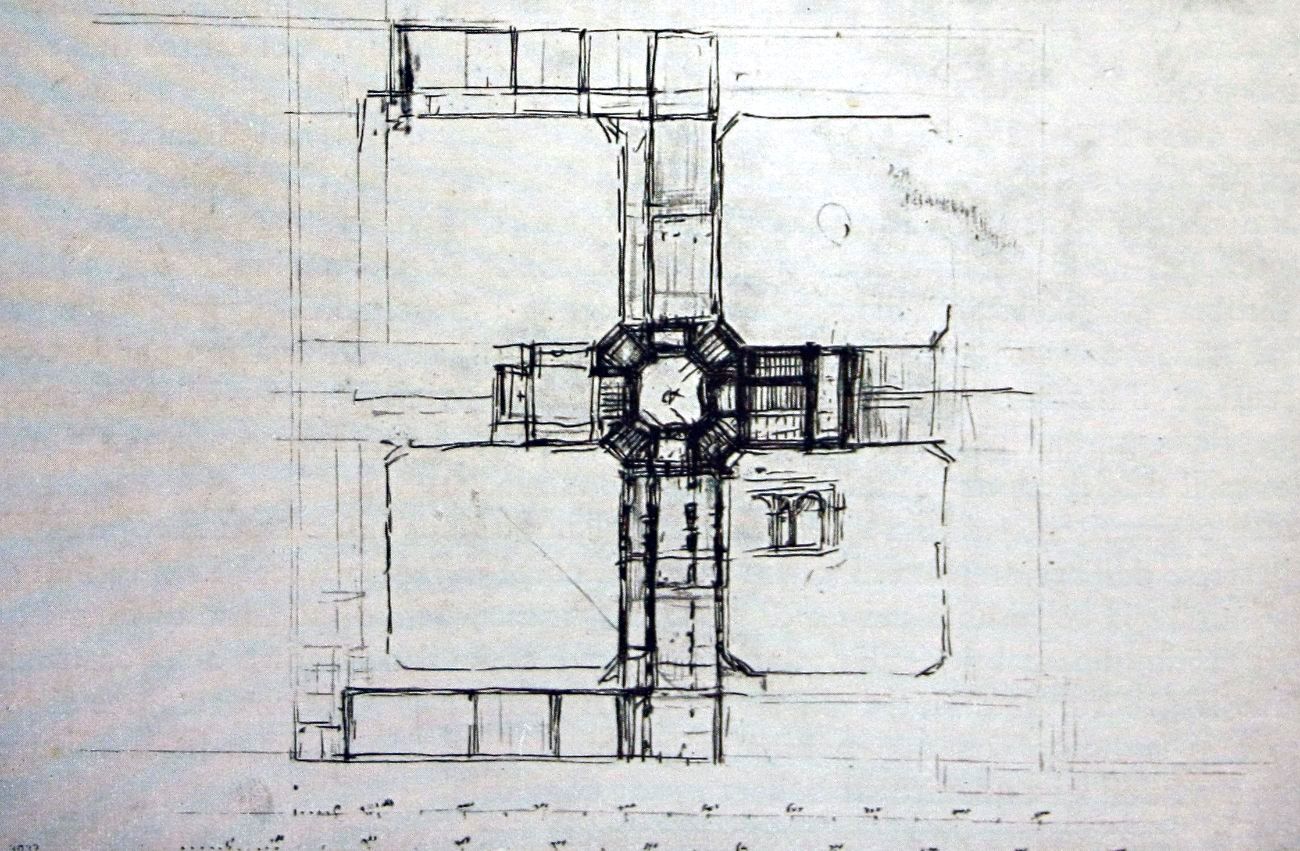
- Pianta dello Scalone
-
- Sezione dello Scalone
The columns
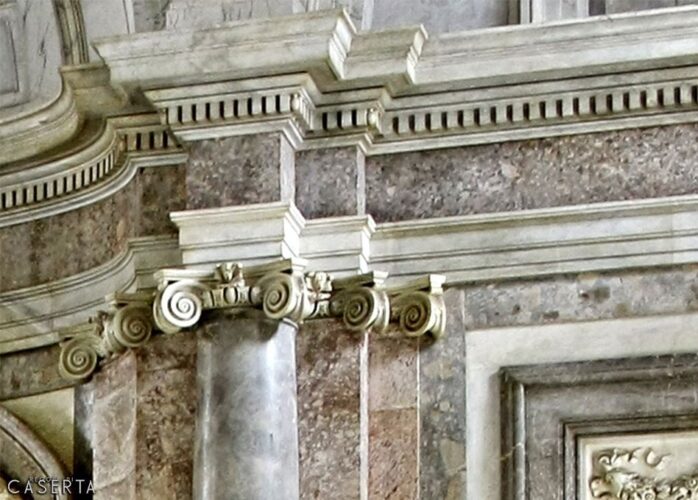
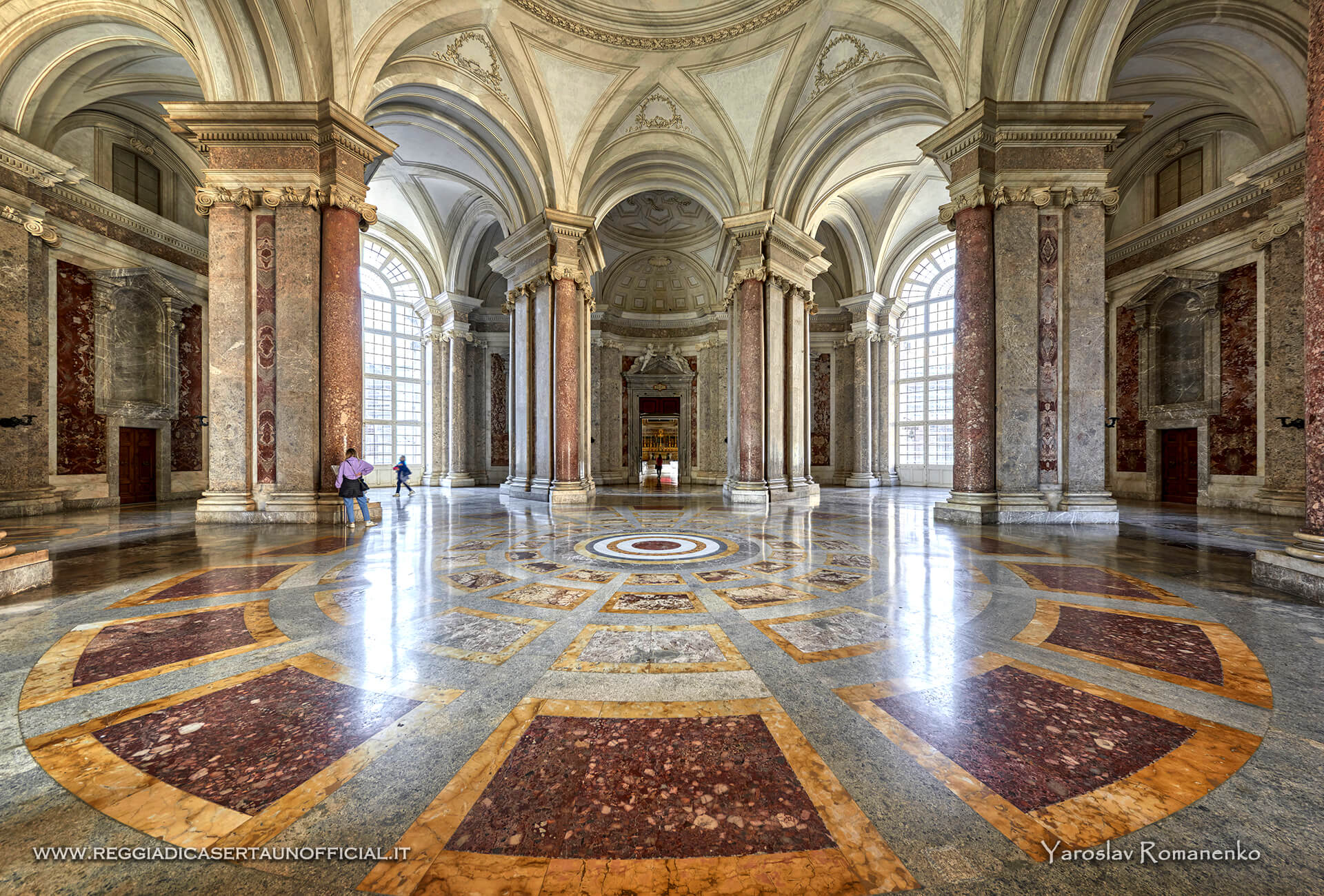
The walls of the Grand Staircase are punctuated by minimal protrusions and recesses, elegant decorations and Ionic semi-columns, and are covered with gray and pink marbles skilfully arranged to create a subtle chiaroscuro effect. The Ionic semi-columns have a giant order1, are flanked by pilasters2, and frame the window compartments. For greater precision it must be stated that it is partially incorrect to speak of semi-columns, as they are incorporated into the wall only for 1/4.
Lighter and more delicate than the previous Tuscan order of the lower vestibule, the Ionic one, despite not reaching a particular perfection, has the merit of being almost free from defects, as it is not too massive like the Doric order, nor too refined like the Corinthian.
Following the principles of Vitruvius and Vignola, to remedy the bad ionic base (the heavier elements that compose it are not placed at the bottom, but at the top, and this damages the solidity), Vanvitelli replaces it with the beautiful base attica: two toruses (discs) of different thicknesses connected by a scotland (recess), creating a magnificent effect, as it integrates solidity and beauty.
Instead of the flat Ionic capital he used the modern Ionic capital , which having protruding volutes and the concave abacus, allowed it to stand out from the wall. The ionic entablature is simple and elegant, and divided into three bands of different heights.
The proportions

The analysis of the proportions of the columns of the Grand Staircase of Honor of the Royal Palace of Caserta
The proportions of the individual elements are very close to the Ionic order described by Palladio in which the column is 19 modules high and the entablature 4. In fact, in our case, the column is equal to 19.5 modules and the entablature is always 4.
Vanvitelli did not have any second thoughts about the architectural order to choose: the Ionic order is used both in the drawings of the Declaration and in the execution. The proportions of the column remain roughly the same, what changes significantly is the entablature: in the project it is 2.5 modules high, in reality double that.
In the Scalone d’onore, taken as a whole, the use of the order is completely classic, as excluding the niche from the coffered vault that houses the central statue, there is no trace of details of Baroque derivation.
Vanvitelli, in general, fully confirmed himself as an exponent of neoclassicism, trying to use the classical orders according to the ideal canons. The perfect correspondence in proportions to Vignola and Palladio are proof of this. The architect grants the innovations or variations from the model in the Tuscan style, in search of an otherwise unobtainable impetus, and in the individual parts of the orders, in particular the bases and capitals: the former more rational and effective in giving the idea of valid support to the column, the latter, particularly in the composite, simpler and more elegant, in search of the sobriety that distinguishes his work in Caserta. The architect emerges from the research as a protagonist of his time who ferries the Italian architecture of the eighteenth century from the Baroque to the Neoclassical.
- 1 Giant order: when the height of the column is greater than that of a floor.
- 2 Lesena: semi-pillar protruding from a wall.
Light control
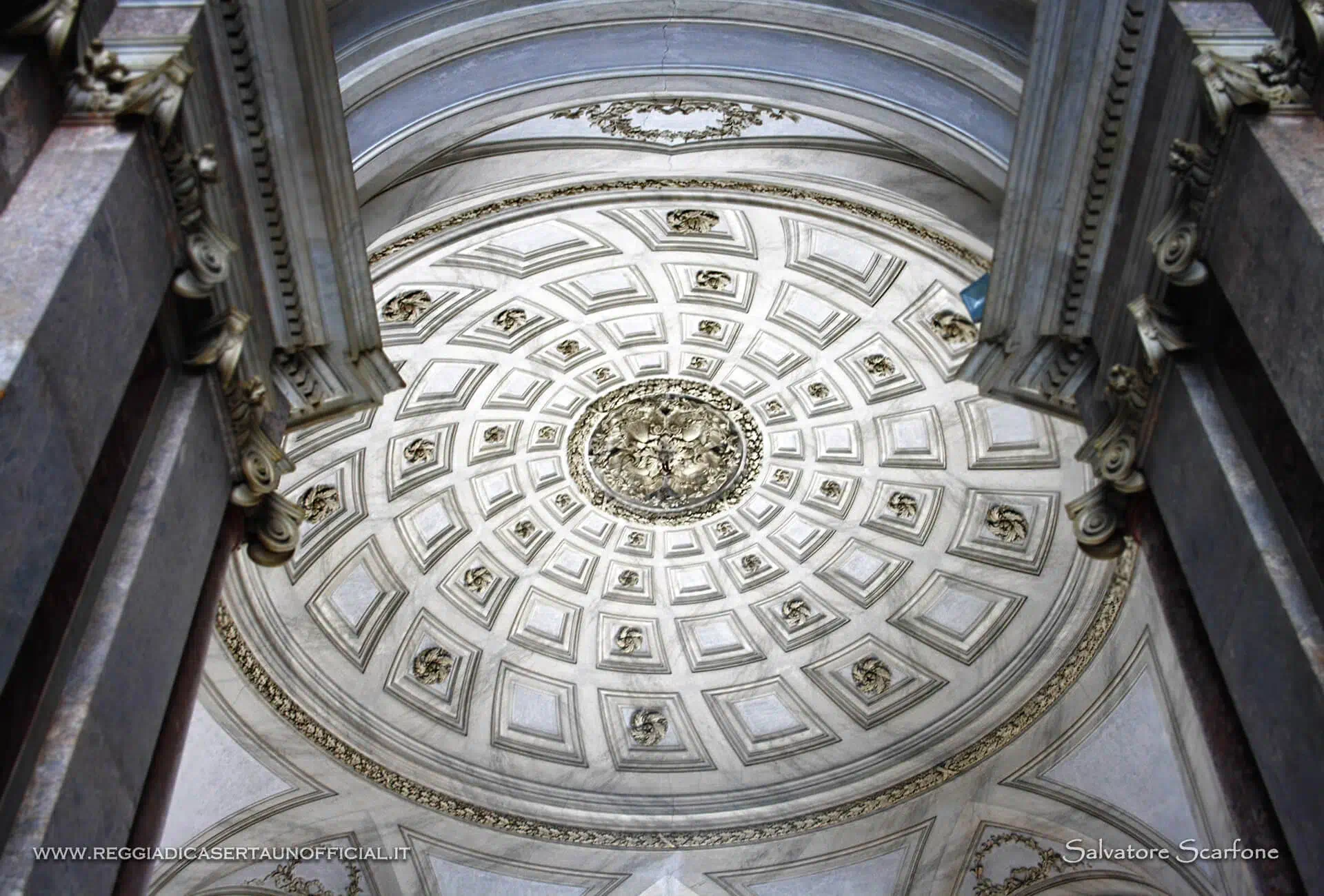
In the Grand Staircase there is an extraordinary lighting control. The windows are placed very high up, and are of two types:- a row of smaller, barrel-shaped upper windows (two are painted, therefore fake) ;
- a second row of rectangular shape and much larger in size.
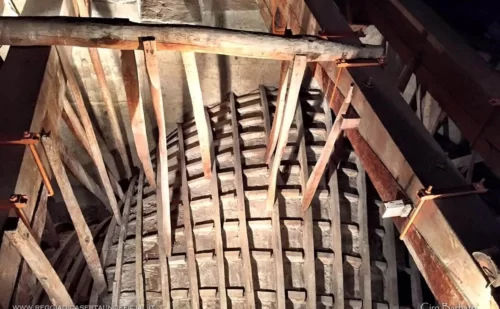
Under the roof
-
- La struttura che regge la cupola dello scalone della Reggia di Caserta
-
- 1880-1934
-
- –
-
- 1880-1934

-
- 1920