
How big is the Royal Palace of Caserta, really?
The Royal Palace of Caserta is said to cover an area of 47,000 square meters and to be the largest in the world by volume. But how can it be the largest in the world if there are other royal palaces with a greater floor area? Let’s discover the truth. How big is the Royal Palace of Caserta really?
AUTHOR: Salvatore Scarfone
The question of square meters
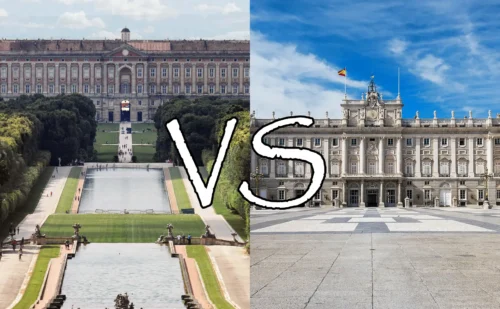
How is it possible that, for example, the Royal Palace of Madrid has a declared surface area of 135,000 m² (almost three times that of the Royal Palace of Caserta), when it has been shown to be one-quarter the size of the Royal Palace of Caserta?
Floor area (in square meters) or the number of rooms does not constitute a valid basis for comparison, as it is very easy to increase these figures:
- creating small rooms instead of large halls to increase the count. For example, instead of a single 100 m² hall, the space could be divided into four rooms of 25 m² each, thereby quadrupling the stated number of rooms.
- constructing rooms with a height of 3 m instead of 10–15 m, thereby creating 3–5 levels rather than one and multiplying the total floor area by a factor of 3 to 5.
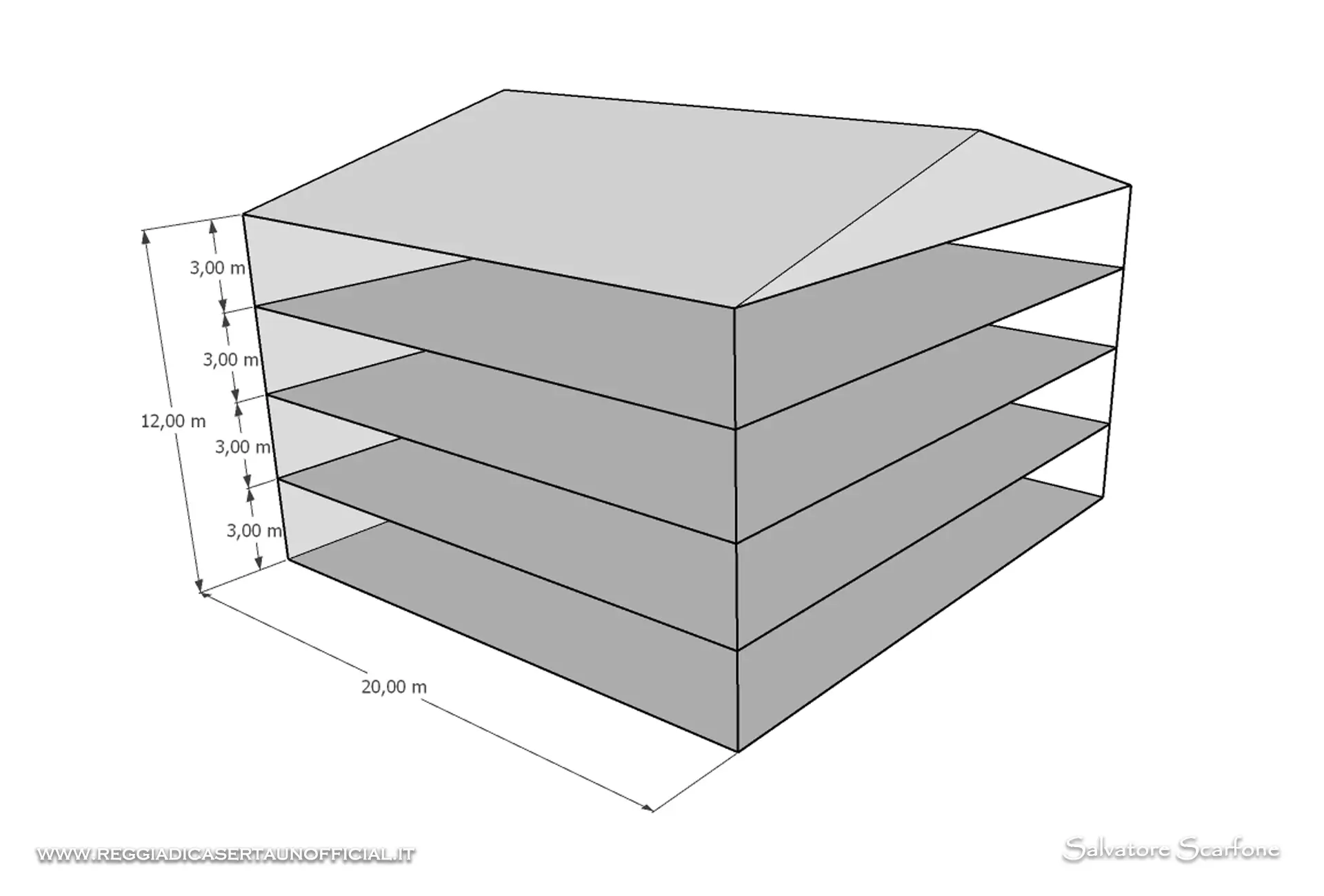
Instead of creating a single hall with a height of 12 meters, the space can be divided into four levels with significantly reduced heights, thereby quadrupling the total available floor area and the overall number of rooms.
The true dimensions of the Royal Palace of Caserta
A digital reconstruction of the Royal Palace of Caserta’s floor plan reveals that its footprint covers approximately 28,000 square meters. Taking into account the building’s vertical structure—comprising five main levels and two underground levels—the total actual floor area reaches a minimum of 140,000 square meters (excluding the two underground levels, four internal courtyards, and the two buildings on the square). Consequently, the actual dimensions of the Royal Palace of Caserta are as follows:
- Dimensions (LxWxH): 247m x 190m x 36m (42m max);
- Area: approx. 140,000m² across 5 floors (excluding two underground levels, 4 courtyards, and two buildings on the square);
- Volume: 2,000,000m³ (it is the largest royal palace in the world);
- Miscellaneous: 1,200 rooms, 1,742 windows, 1,026 fireplaces, 56 staircases;
The figure of 47,000 square meters actually represents the ground area occupied by the building (excluding the two buildings on the square); indeed, simply multiplying the palace’s dimensions—247m x 190m= 46,930m² (so 47,000). However, the true floor area, as demonstrated above, is at least 140,000m² (excluding the two underground levels, four internal courtyards, and the two buildings on the square).
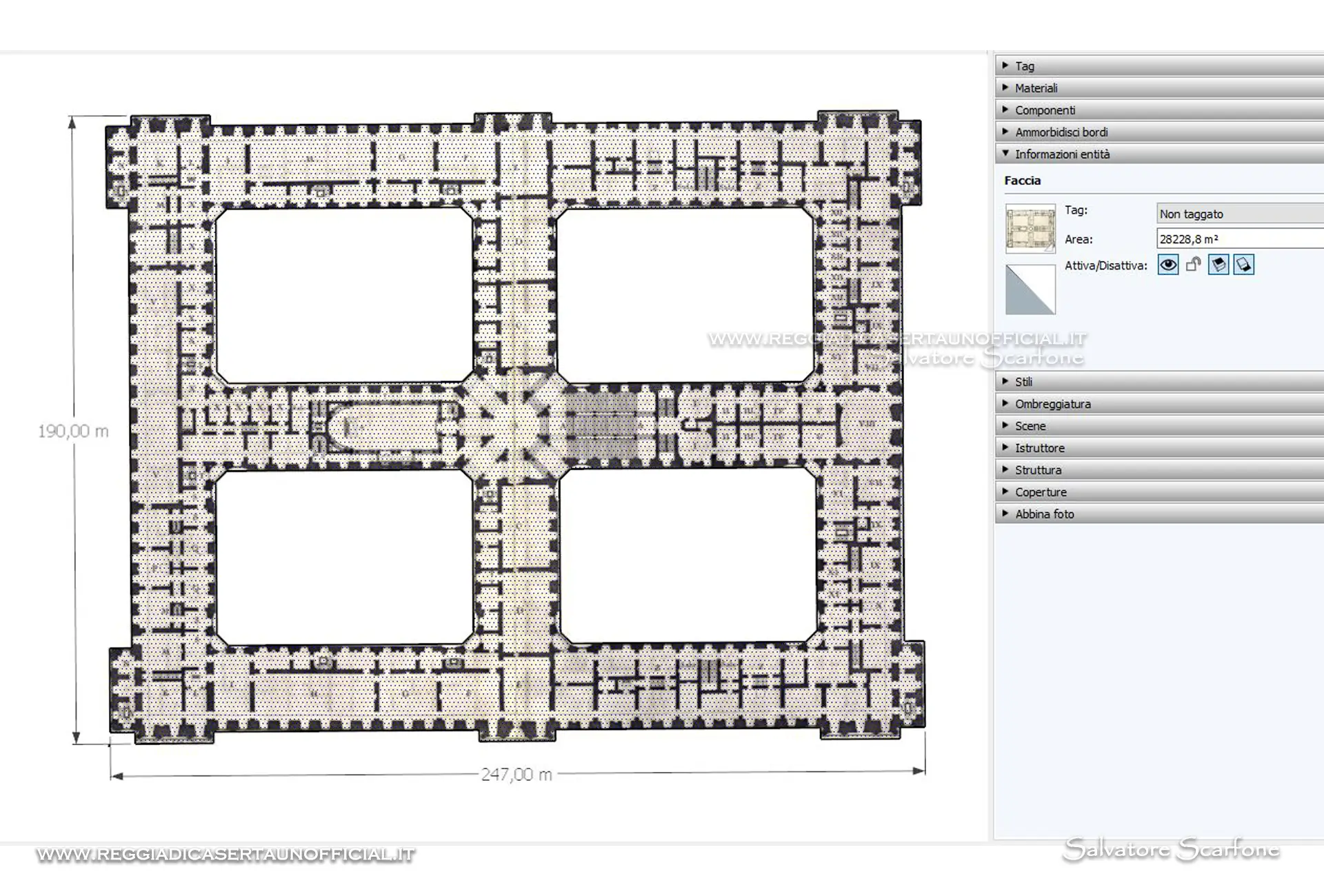
Computer simulation reveals that the Royal Palace has an area of 28,000 square meters per floor. Given that the Royal Palace has five floors plus two underground levels, its total surface area amounts to a minimum of 140,000 square meters (excluding the two underground levels, four internal courtyards, and the two buildings on the square).

Showing Slide 1 of 7: How big is the Royal Palace of Caserta, really?