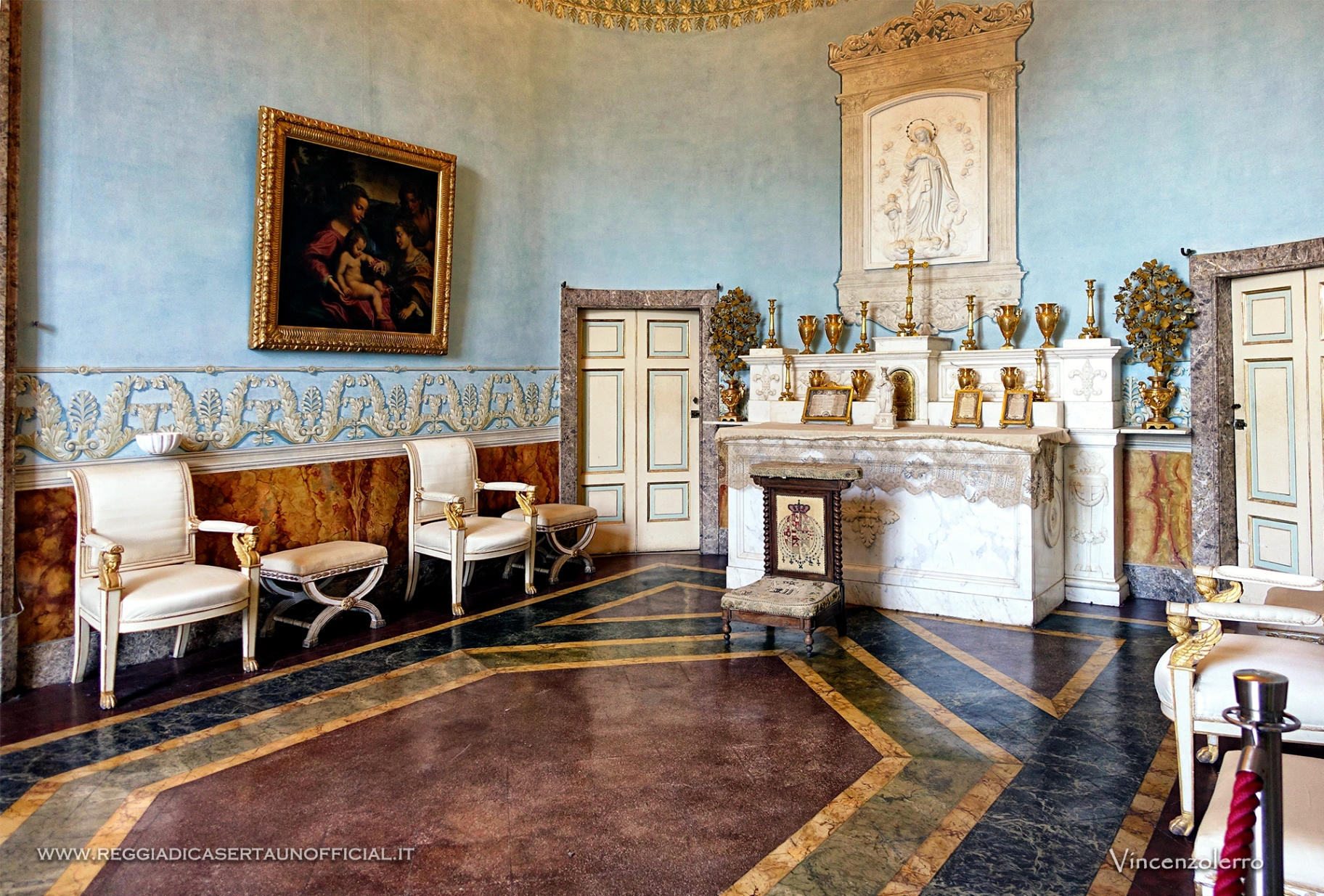
The Chapel, the Small Drawing Room, and the sedan chair of Pope Pius IX at the Royal Palace of Caserta.
Two small rooms that tell the story of the close relationship between the Bourbons and the Papacy in the mid-19th century.
Pope Pius IX and the Bourbons
Following the assassination of Prime Minister Pellegrino Rossi and the attack on the Quirinal Palace, Pope Pius IX fled Rome in November 1848 and sought refuge in Gaeta under the protection of King Ferdinand II of Bourbon. During his stay in the Bourbon kingdom, the Roman Republic was established in Rome (February 1849). From Gaeta—which for several months served as a sort of “second Papal State”—the Pope issued decrees and appealed to European Catholic powers to help him regain his temporal authority. It was also here, inspired by the Bourbons‘ fervent devotion to the Virgin Mary, that he contemplated establishing the Feast of the Immaculate Conception, which he subsequently proclaimed for December 8th.
On October 15, 1849, the Pontiff arrived in Caserta by train and was welcomed by King Ferdinand II of Bourbon and a multitude of the faithful. After a brief stop in the Palatine Chapel, the Pope appeared on the Royal Palace’s main balcony to bestow his blessing. He paid a second visit on November 7, 1849. At Christmas that same year, Pius IX stayed at the Royal Palace and officiated the Holy Night Mass in the Palatine Chapel.
The intervention of French military forces under Louis Napoleon defeated the Roman Republic in July 1849, enabling the Pope to return to Rome in April 1850.
The monumental cup currently located in the center of the Hall of Mars was presented to King Ferdinand II as a token of gratitude for having been a guest of the Bourbons during his exile in Gaeta.
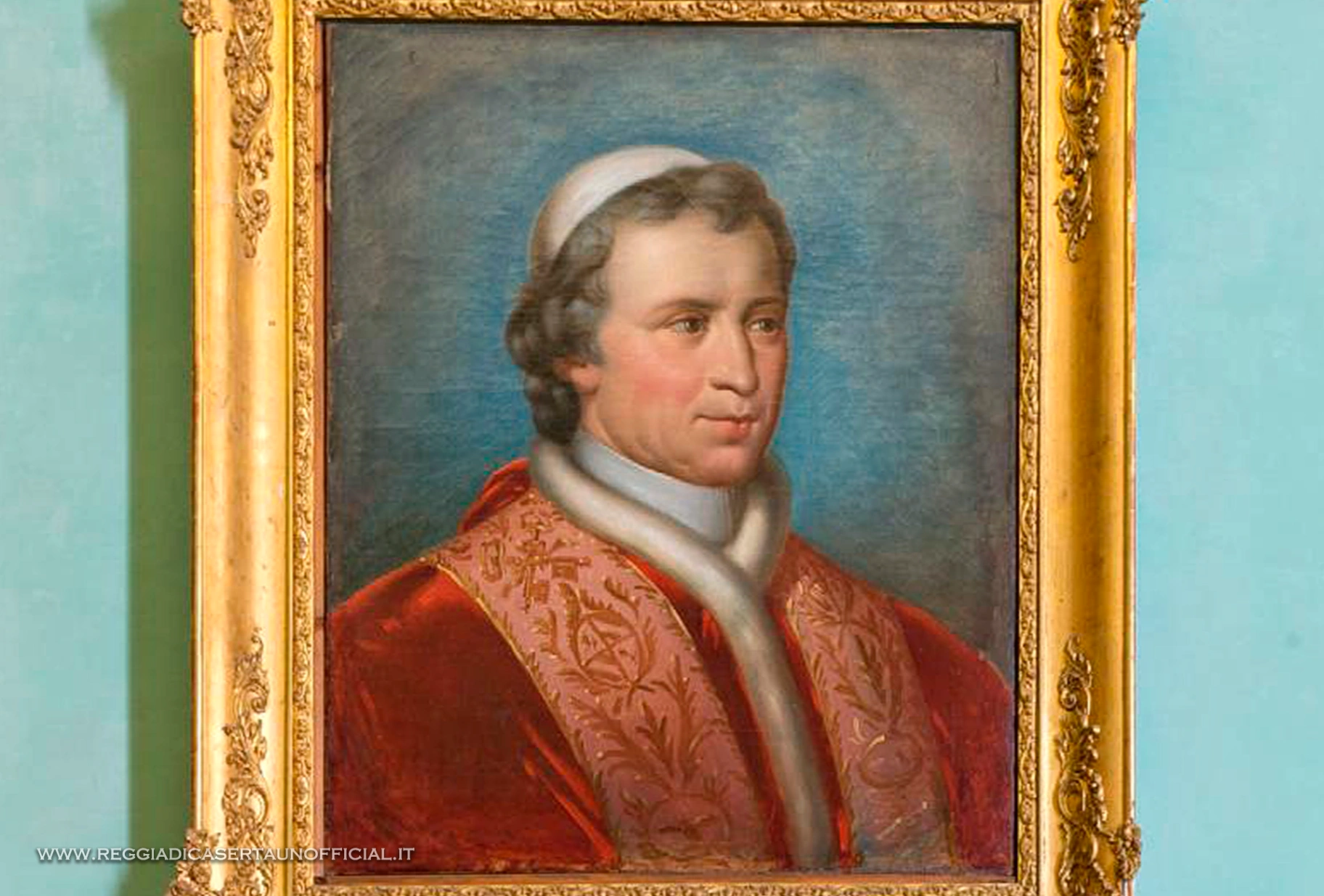
Tommaso de Vivo “Portrait of Pope Pius IX” – 1846–56

Franz Vervloet “View of Gaeta on the occasion of the blessing given by Pius IX on December 8, 1848” – 1850
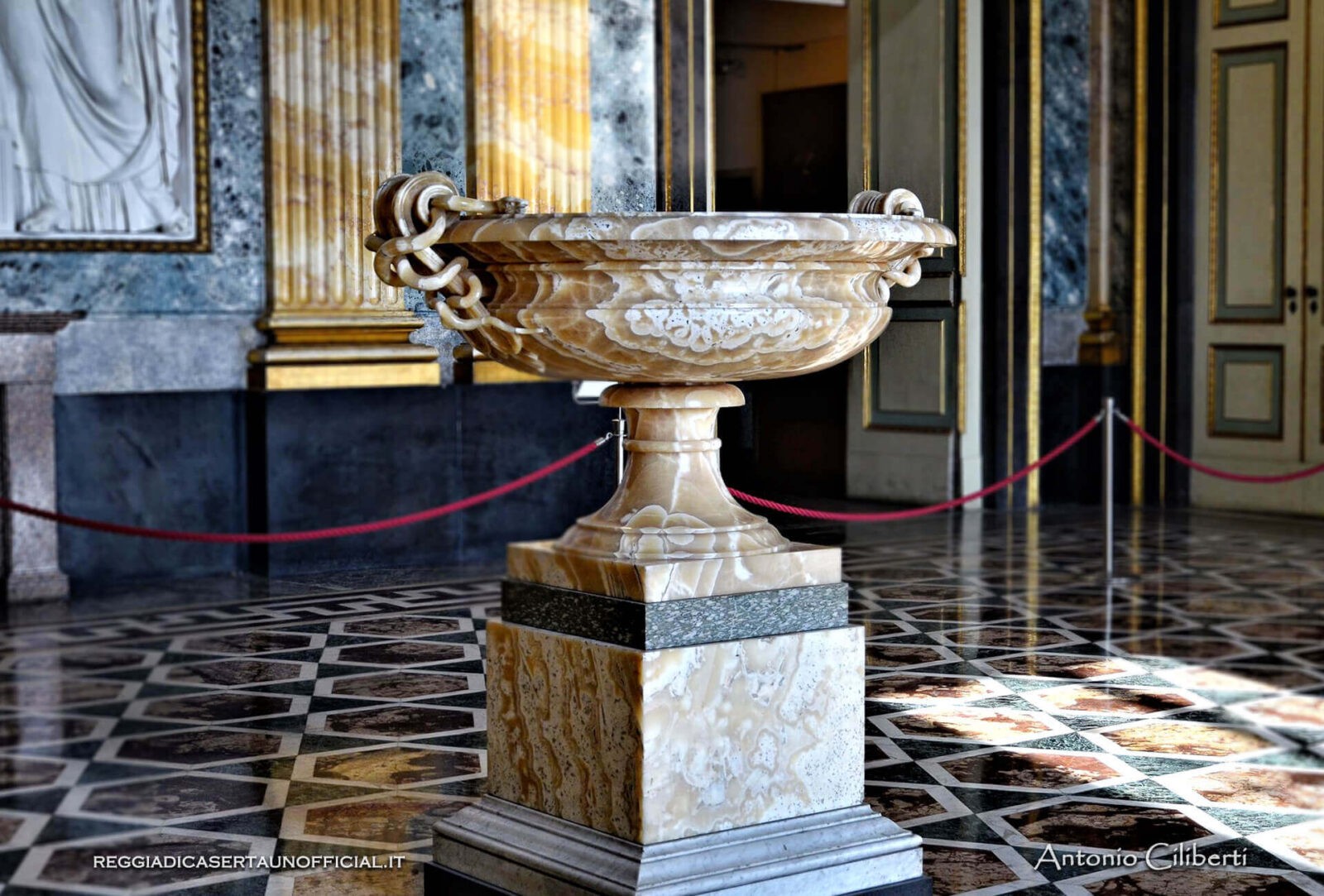
Monumental alabaster cup in the Hall of Mars, gifted to the Bourbons by Pope Pius IX in gratitude for the hospitality received
The Chapel of Pope Pius IX (originally dedicated to the Madonna)
The small chapel—originally a court oratory dedicated to the Virgin Mary (whose monogram appears at the center of the ceiling)—was later dedicated to Pius IX (born Giovanni Maria Mastai Ferretti) during his stay at the Royal Palace in 1850. This dedication reflects the positive political and religious relationship established between the Pontiff and the Bourbon dynasty—represented at the time by King Ferdinand II—during the late 1840s and early 1850s. The Pope had been forced to flee Rome during the revolutionary upheavals of 1848.
The monogram on the ceiling is a Marian monogram familiar to us all; it consists of the letters A and M, standing for *Auspice Maria* (“under the protection of Mary”) or the Archangel’s greeting, *Ave Maria*.
Facing the entrance stands a Carrara marble bust of Pope Pius IX Mastai-Ferretti (Senigallia 1792 – Rome 1878)—signed and dated 1849 by the Tuscan sculptor Lorenzo Bartolini—which was presented to the Pope by Prince A. Demidoff. Housed in this small space is a Carrara marble altar attributed to the architect Antonio Niccolini (first half of the 19th century), while the relief on the altar, *Virgin and Angels*, is the work of Gaetano della Rocca.
Religious paintings adorn the walls.
The Chapel of Pope Pius IX
The fresco and the walls
Both the fresco and the room are in the Empire style, dating from the first half of the 19th century. The monogram on the ceiling is a Marian monogram composed of the letters ‘A’ and ‘M’; these stand for either *Auspice Maria* (“under the protection of Mary”) or the Archangel’s greeting, *Ave Maria*. The choice of the color blue was deliberate: on one hand, as it is associated with the Virgin Mary, it symbolizes purity, royalty (*Regina Coeli*), and belonging to the divine realm; on the other, it is the color of the House of Bourbon (note the Bourbon lily on the altar).
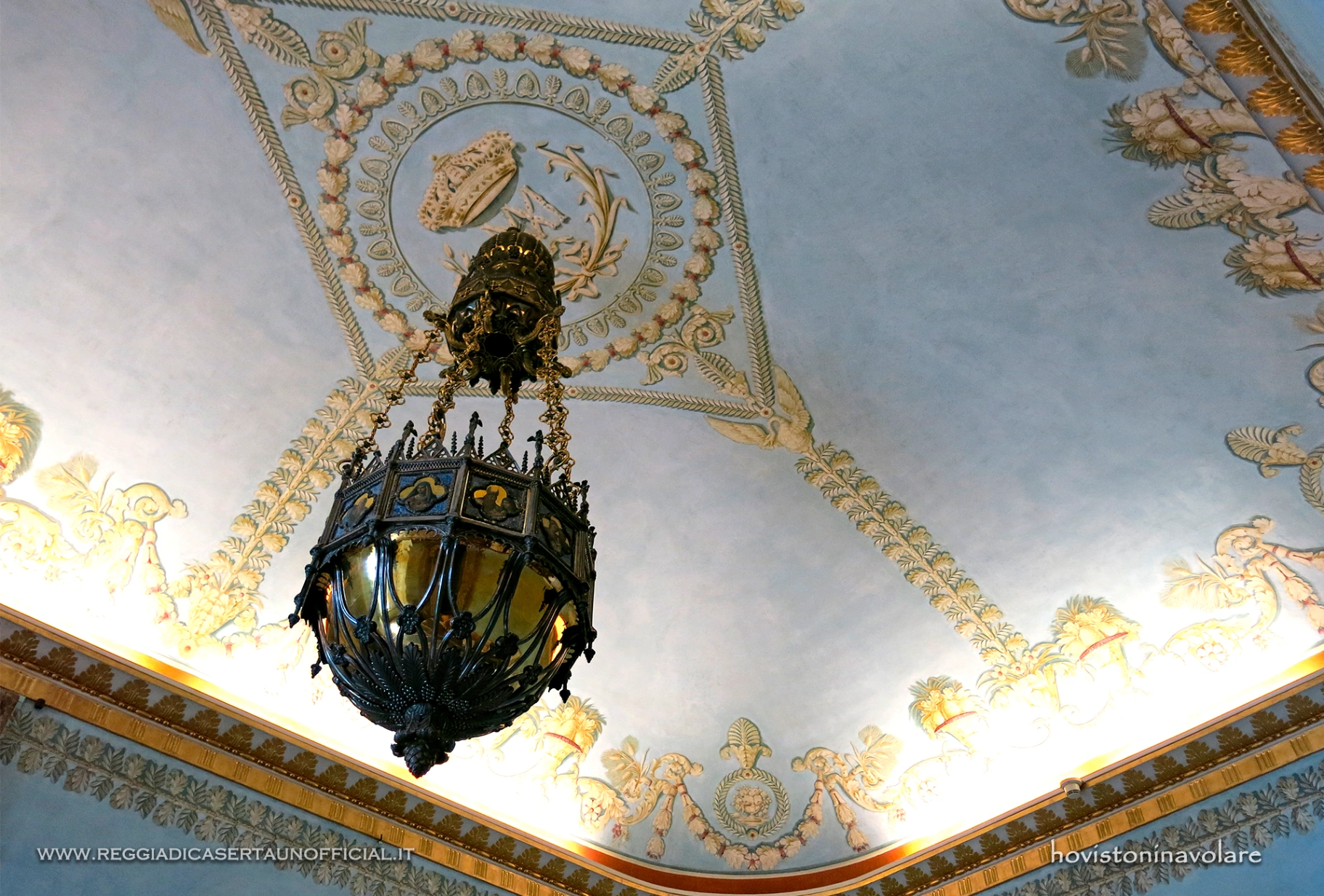
The ceiling fresco featuring a Marian monogram in the center and a Neo-Gothic chandelier

The Marian monogram dedicated to the Virgin Mary, featuring the intertwined letters A and M, signifying “Auspice Maria.”
Furnishings and objects
Some of the items included:

Neo-Gothic chandelier in partially gilded silver, featuring painted glass panels depicting sacred subjects and faux lapis lazuli. Mid-19th century. Formerly displayed in the Palatine Chapel, of which it was likely originally a part.
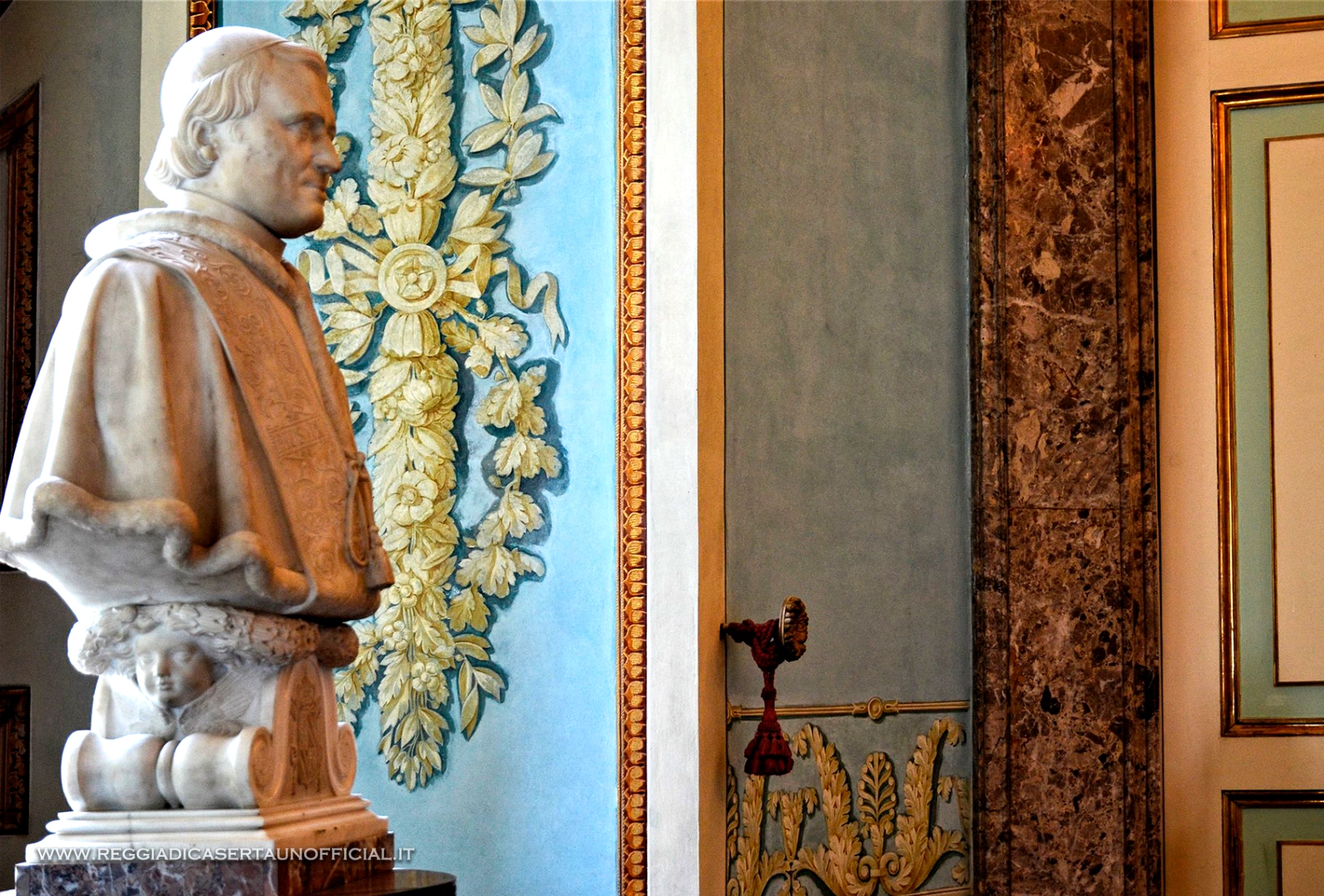
Lorenzo Bartolini, “Portrait of Pope Pius IX”, 1849
The artist created this work in Rome. Offended by the Pope’s indifference—as he did not even examine the plaster model—Bartolini sold the portrait to Prince Anatoly Demidov. The Prince gifted it to the Pope, who in turn presented it—along with the alabaster cup now housed in the Hall of Mars at the Royal Palace of Caserta—to King Ferdinand II.

Gilt-bronze altar set comprising Empire-style candlesticks and a crucifix (early 19th century), along with altar cards and gilt-bronze vases containing silk flowers from the era of Ferdinand II (mid-19th century). In front of the tabernacle stands a small sculpture of the Madonna and Child. Note the Bourbon lilies on the altar.

Prie-dieu. Note the coat of arms of the House of Bourbon-Two Sicilies above, and the monogram of King Ferdinand II of the Two Sicilies below—indicating that this was his personal prie-dieu. Neo-Baroque style, mid-19th century.

Gaetano della Rocca, “The Virgin among Angels and Cherubs,” Carrara marble bas-relief, 1830–1845.
The work, set within a monochrome frame, depicts the Virgin on a cloud surrounded by cherubs, flanked by two putti holding an olive branch and a mirror, symbolizing peace and reflection.
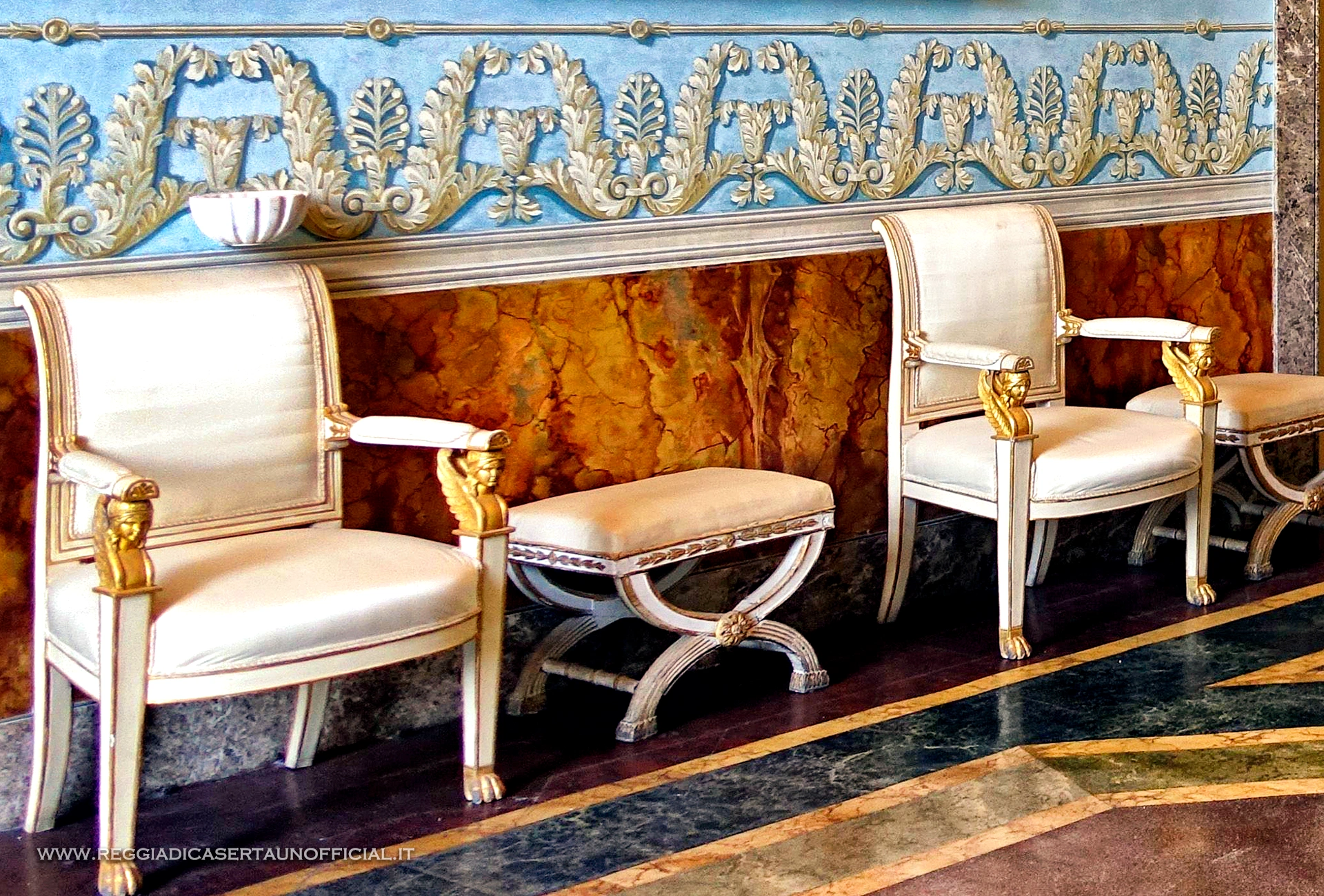
White Empire-style armchairs and stools with gold trim and sphinxes at the corners of the armrests. First half of the 19th century.
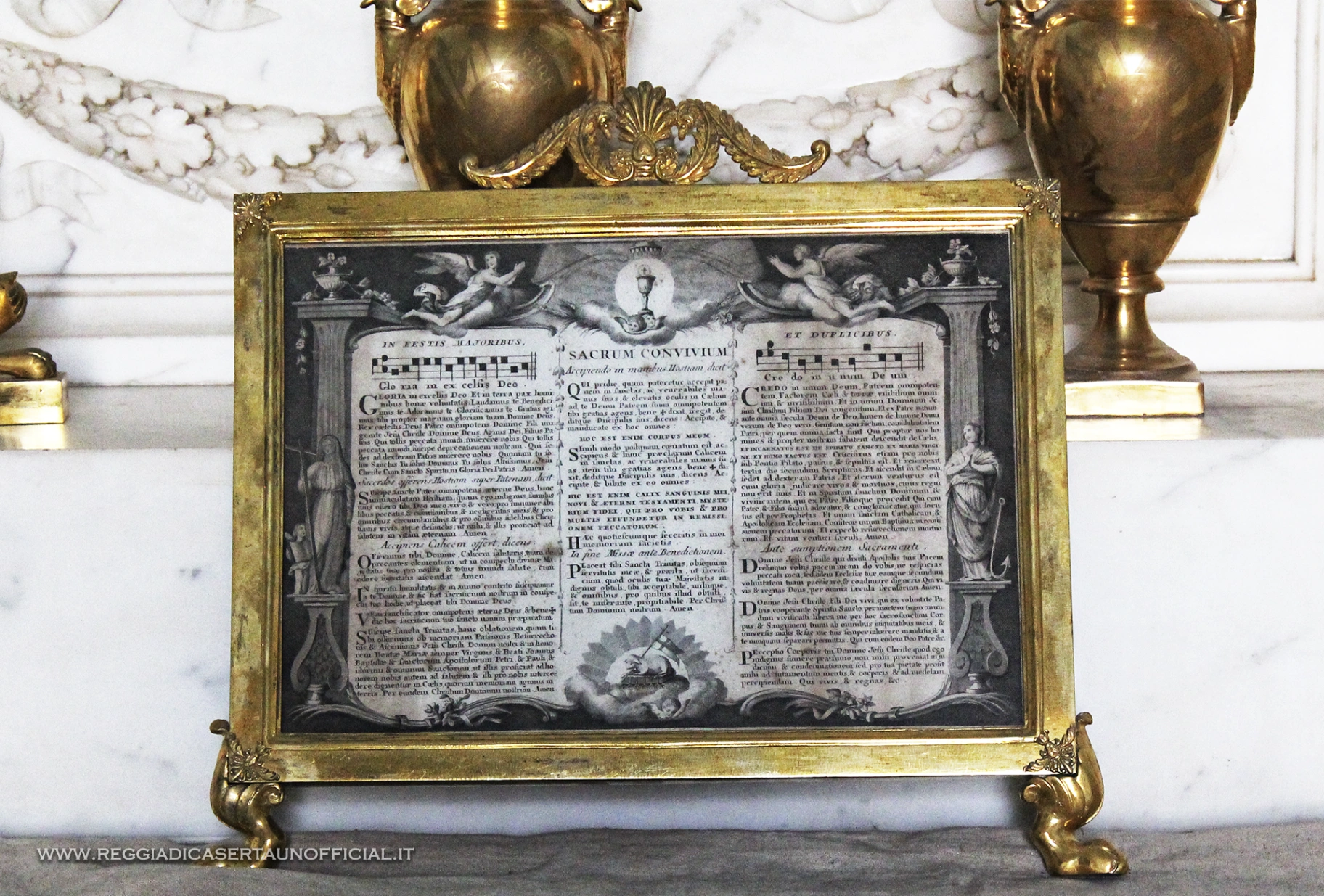
One of three altar cards featuring a rectangular frame and a Neo-Baroque scrollwork motif. Second half of the 19th century. The texts include “Gloria in excelsis Deo,” “Qui pridie quam pateretur,” and the Creed.
The paintings
- two portraits—”Saint Louis, King of France” and “The Holy Family”—by Angela Piazzetta;
- on the right wall, “The Nativity of Christ” by Salviati;
- on the left wall, “The Mystic Marriage of Saint Catherine,” a copy after Correggio;
- beside the window, “The Virgin with the Christ Child,” a copy after Pinturicchio.
The Small Sitting Room and the Sedan Chair of Pope Pius IX
The small room houses the sedan chair used by Pope Pius IX during the Roman Republic of 1848–1849, when he was a guest of the Bourbon monarchs in Gaeta.
Paintings
- On the right wall: a view titled “Gaeta on the occasion of the blessing given by Pius IX,” dated 1850, by the Belgian painter Franz Vervloet, who settled in Naples in 1825.
- On the left wall: two watercolors on paper by Achille Vespa—”Pius IX blesses the Neapolitan people in 1849″ and “Pius IX blesses the troops from the balcony of the Royal Palace of Naples in 1849.”
- Between the two watercolors hangs a portrait of Pius IX from 1846, a work by the Neapolitan painter Tommaso De Vivo.

View of part of the Pope’s Small Sitting Room
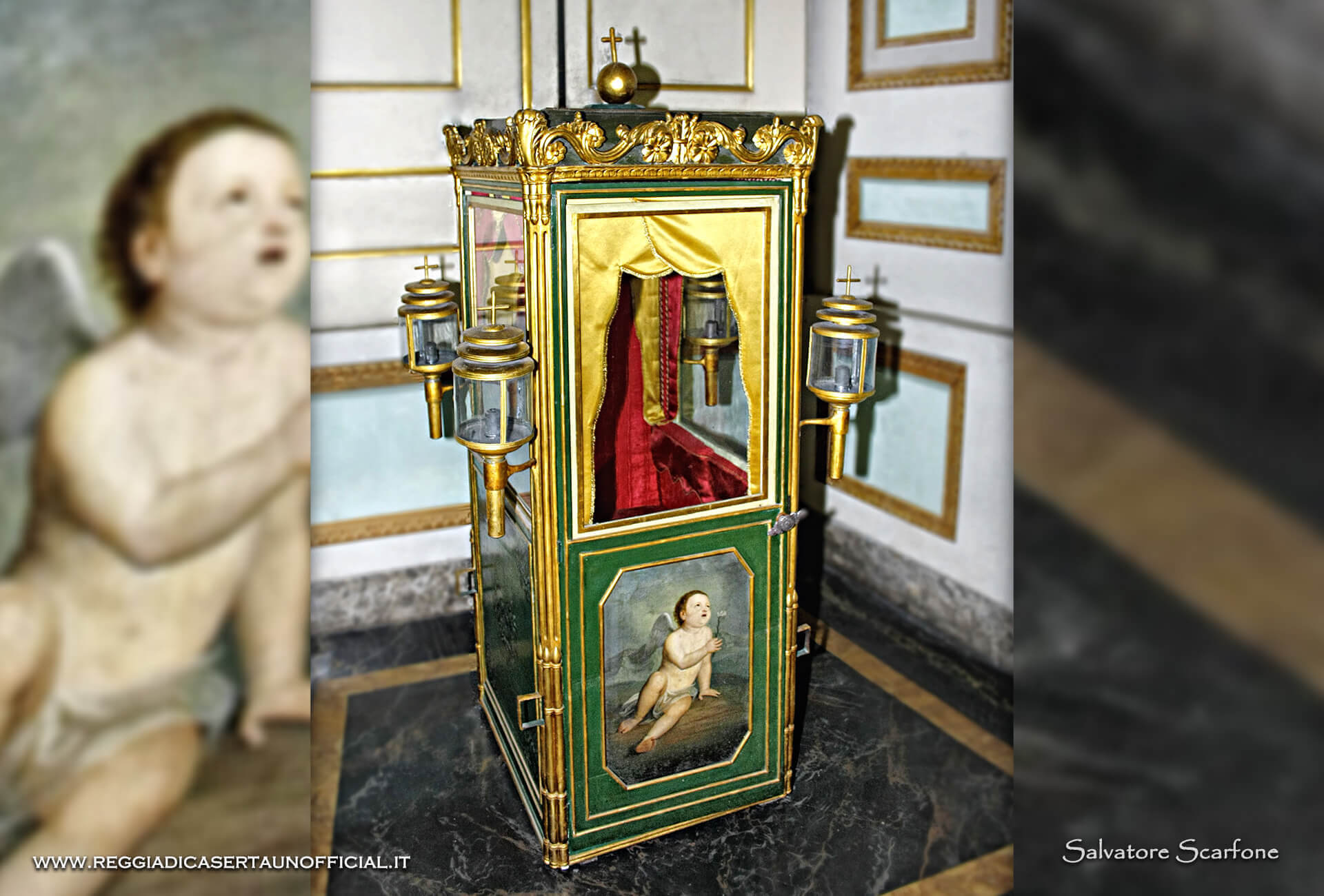
The Pope’s sedan chair. Neapolitan sedan chairs and carriages were renowned in the eighteenth century for the harmony of their design, as well as the refinement and magnificence of their styling and lacquerwork.
Franz Vervloet “View of Gaeta on the occasion of the blessing given by Pius IX on December 8, 1848” – 1850
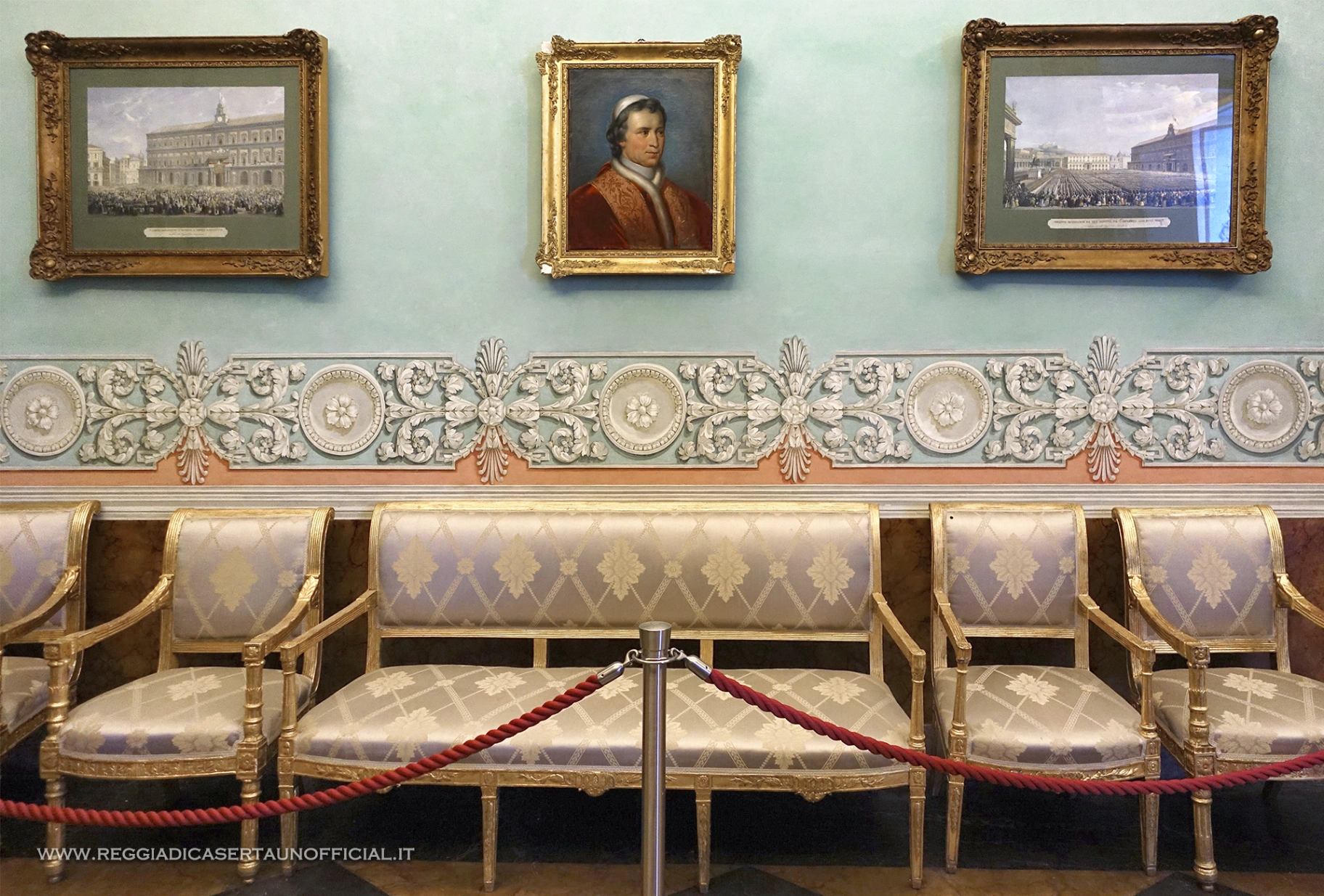
White Empire-style armchairs and stools with gold trim. First half of the 19th century.
External link