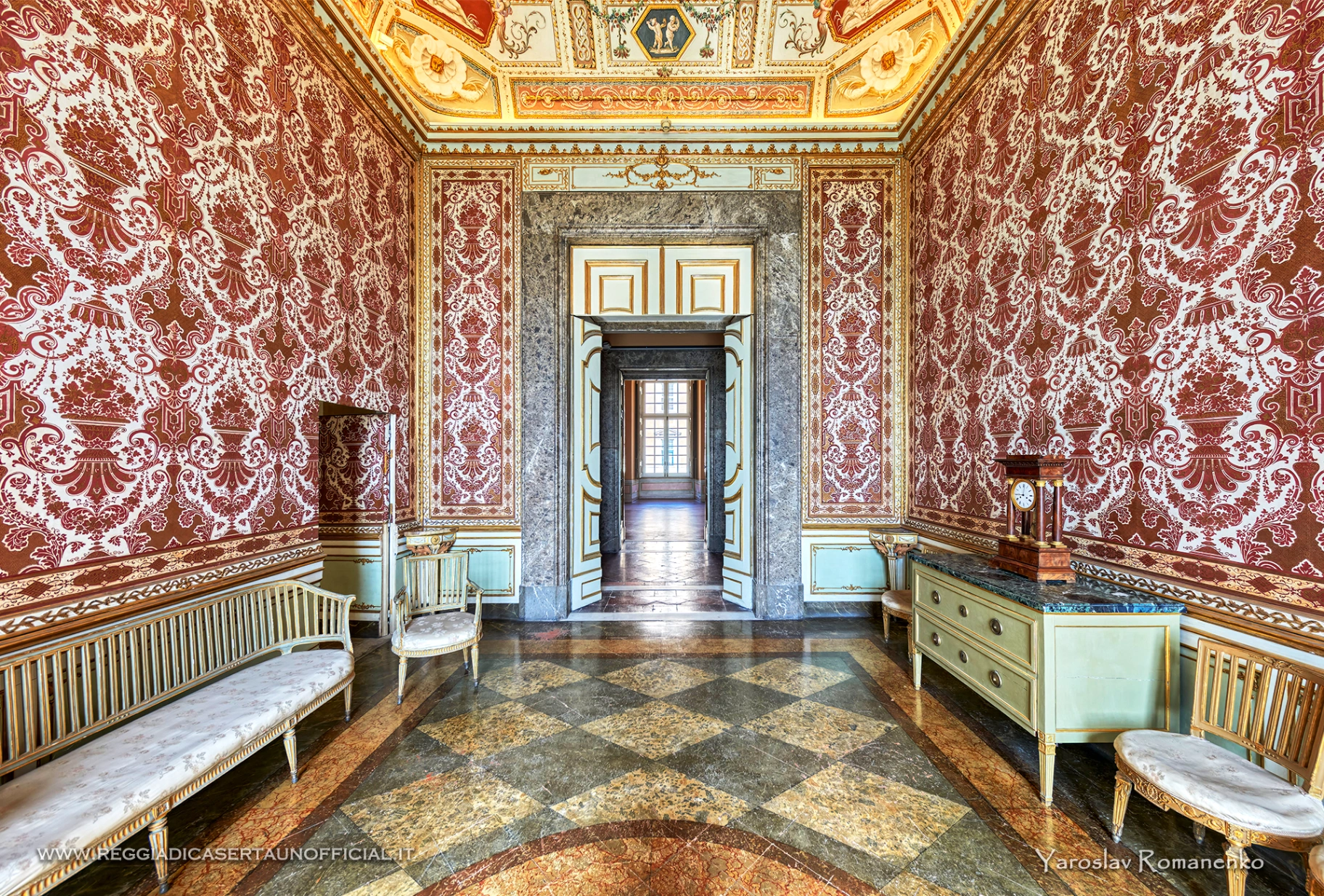
Antechamber to Ferdinand II's Bedroom
The so-called Antechamber to Ferdinand II’s Bedroom was formerly the council chamber, and later the dressing room.
Description
The room serves as a tribute to classical culture, being entirely adorned with decorations inspired by the discoveries at Pompeii and Herculaneum.
The Antechamber is located immediately after the King’s Study; it follows what was once the Council Chamber, which became the King’s Dressing Room in 1830.
Little remains of the room’s original lavish furnishings: the decorative elements on the vaulted ceiling by Filippo Pascale, and the carved overdoor panels and wainscoting executed by Gennaro Fiore between 1779 and 1780.
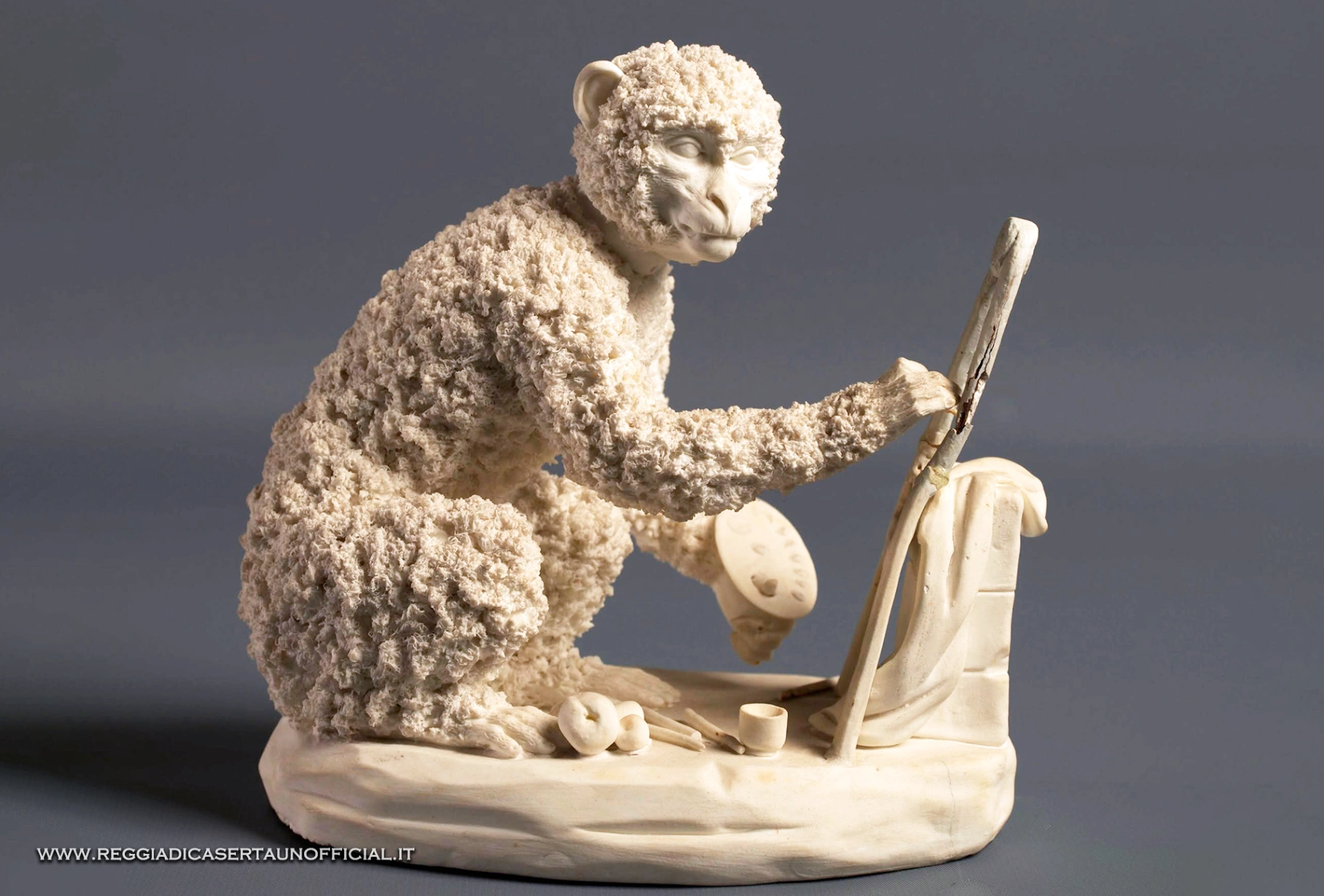
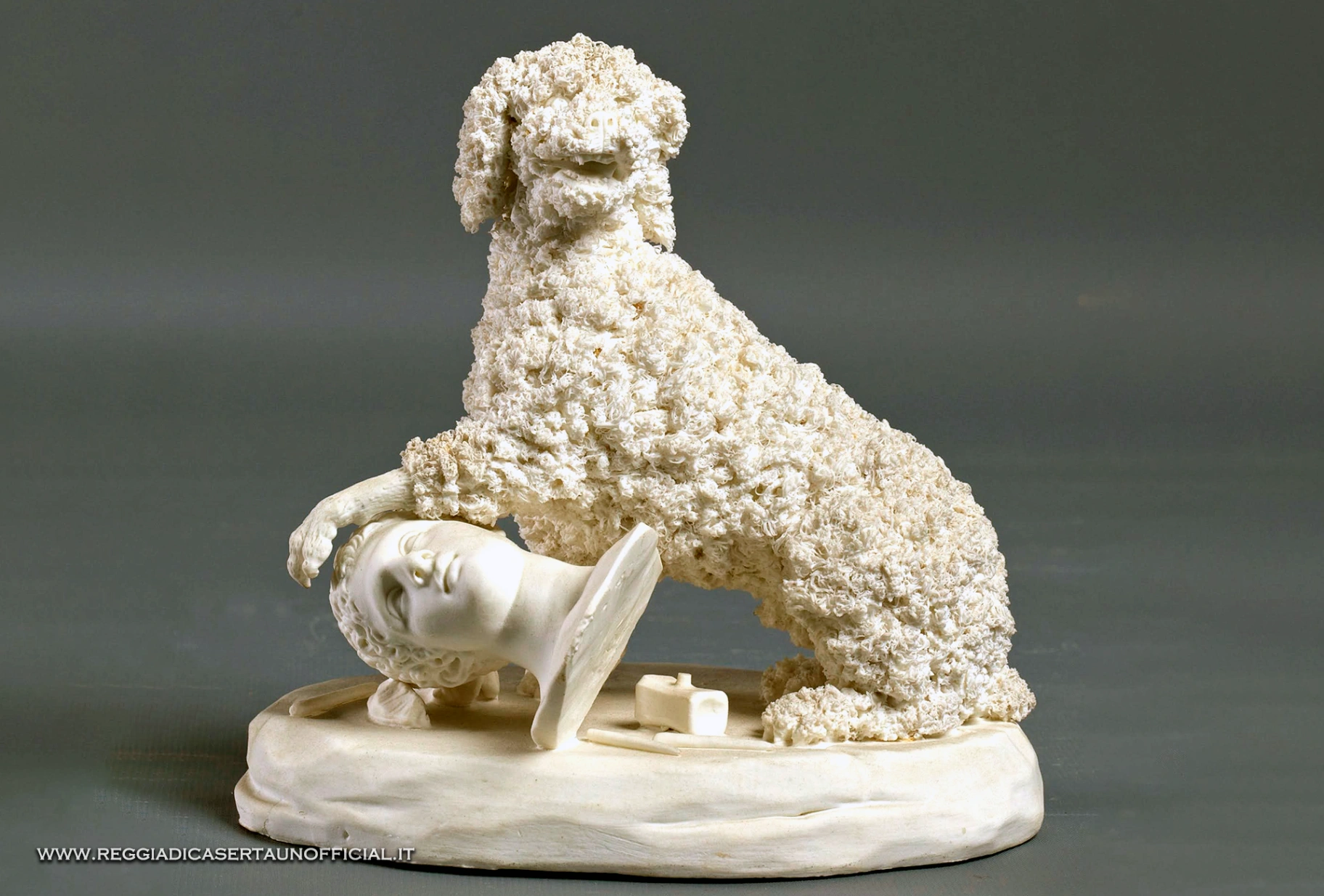
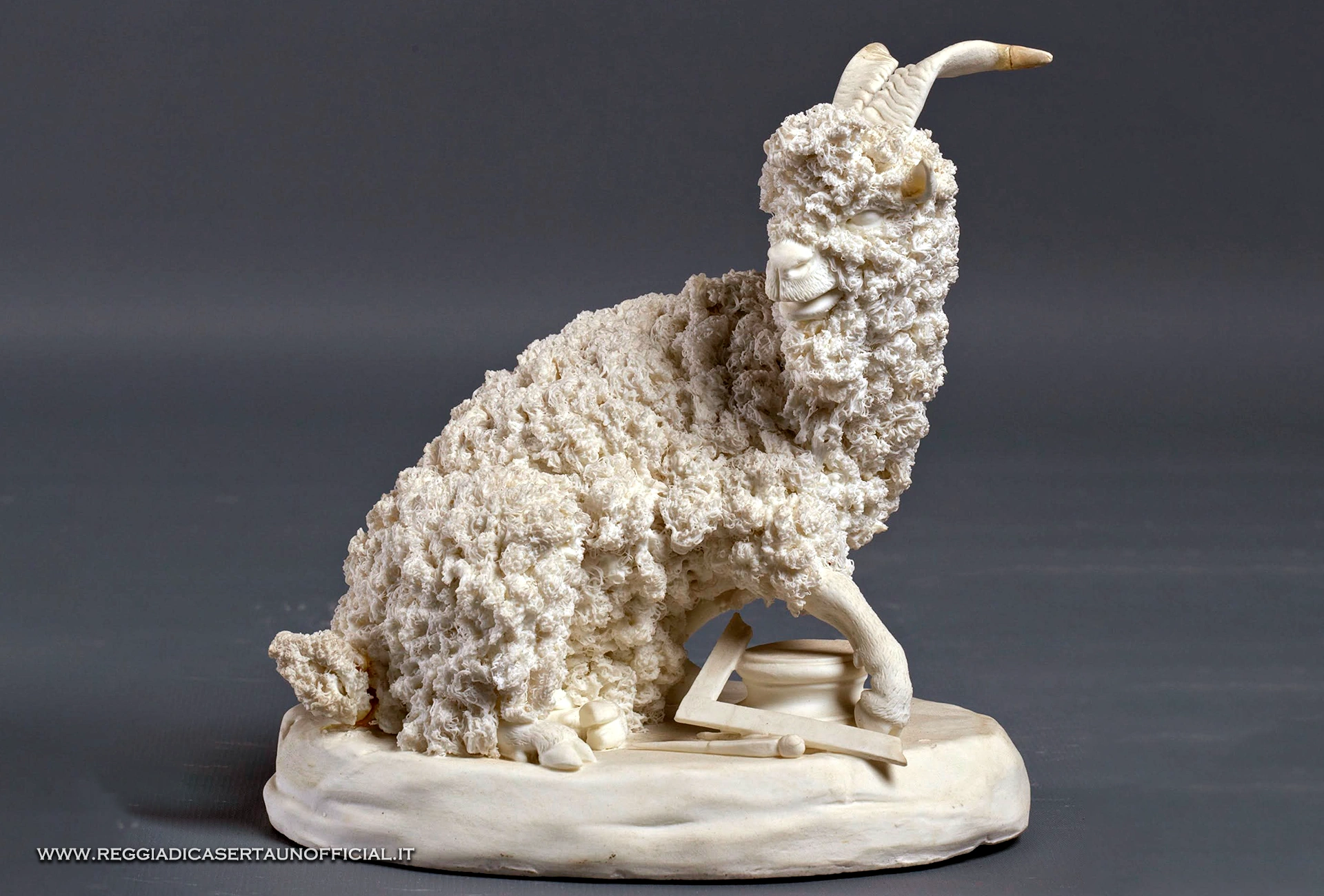
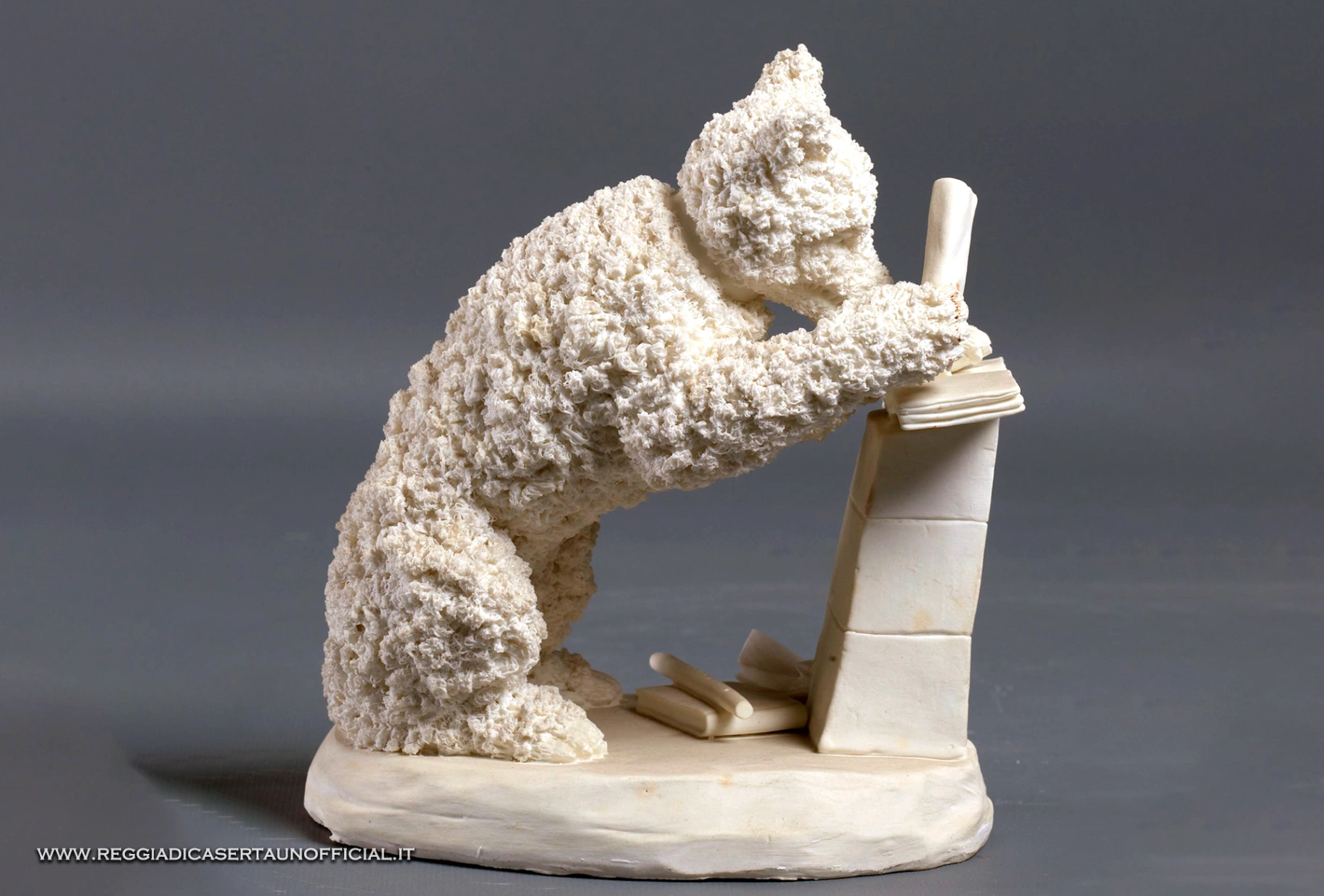
18th-century inventories reveal that this room once housed four biscuit porcelain animal figures—symbols of the liberal arts—displayed under glass domes on black ebony pedestals (now at Capodimonte): a goat (representing architecture), a monkey (painting), a bear (music), and a dog (sculpture).
The room’s vaulted ceiling features frescoes by Filippo Pascale in the Pompeian style. The French-made wallpaper, hand-painted with gold highlights, is of exceptional quality.
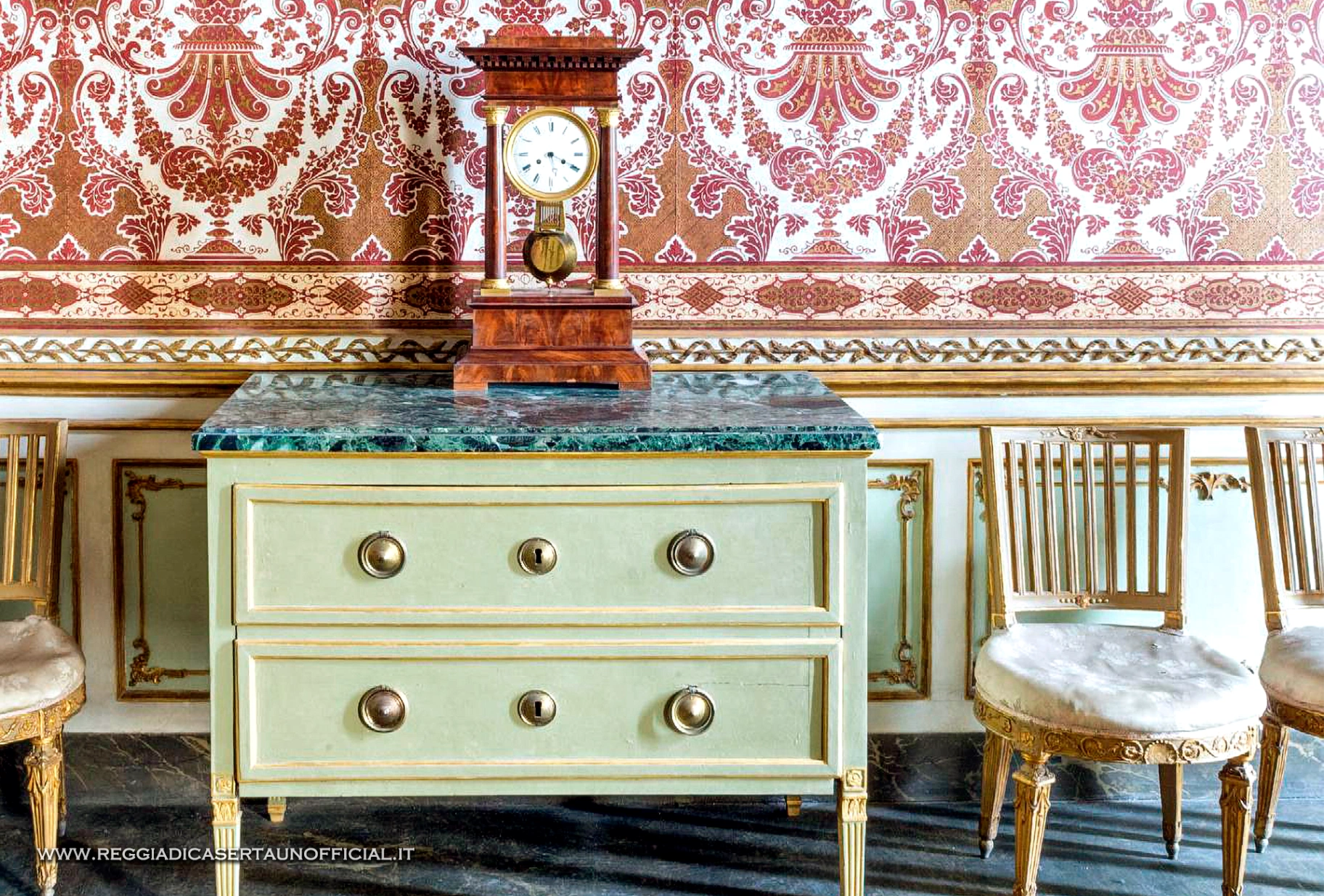
A standout piece among the furnishings is a French-made pendulum clock shaped like a small temple, dating from the first half of the 19th century. A sundial sits on the exterior windowsill, bearing the inscription “Signat et moment” at the top of its disc.
Decorations and furnishings of the Antechamber to Ferdinand II's Bedroom
The fresco
The ceiling of the room is frescoed by Filippo Pascale with Pompeian-style decorations. The intricate design features vegetal and zoomorphic motifs forming garlands, candelabra, and grotesques inspired by Pompeian art.
Mythological figures are painted in monochrome against a dark background within geometric frames, alternating with geometric interlacing patterns. At the corners of the ceiling, small classical heads are set within the centers of scallop shells.
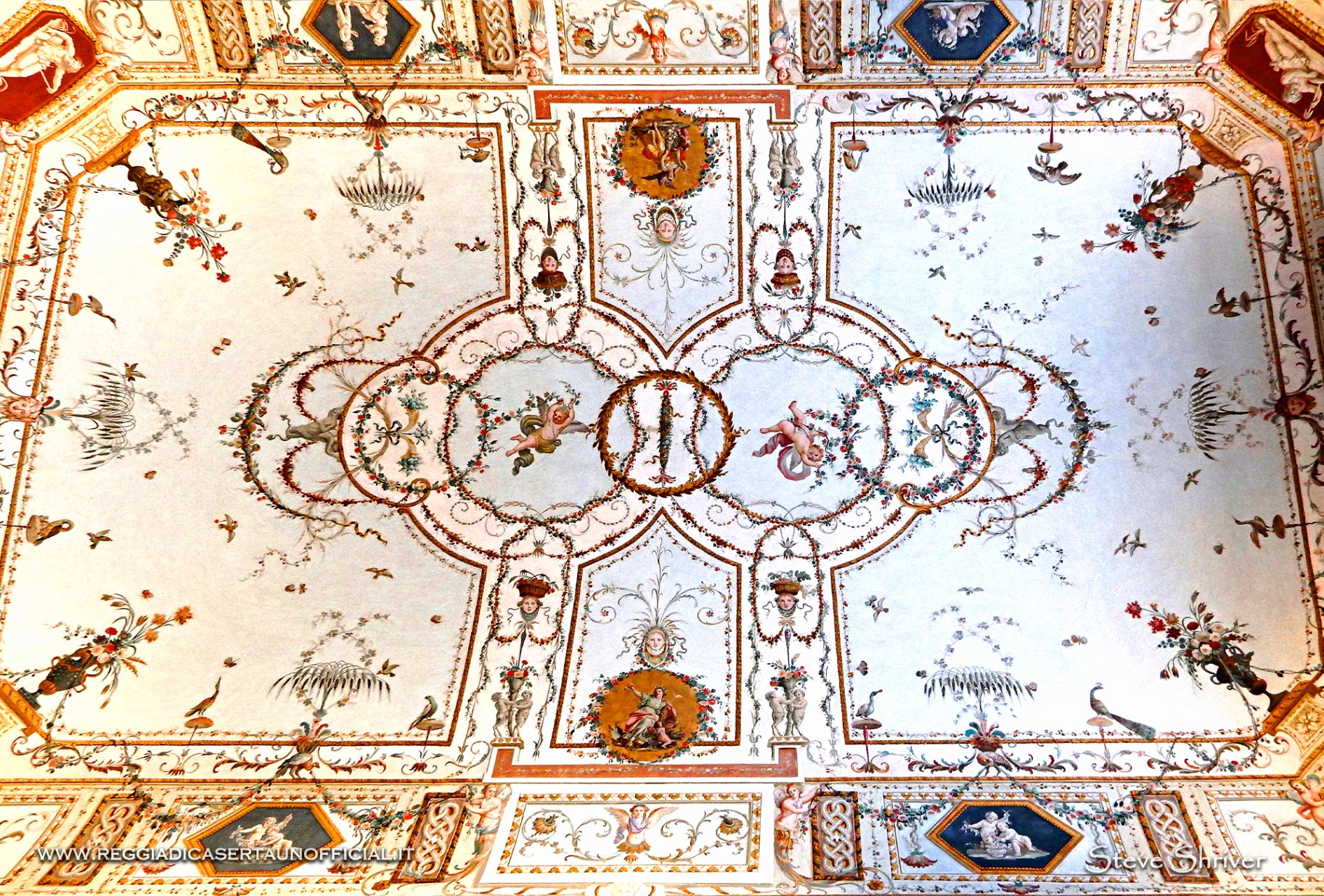
The Pompeian fresco
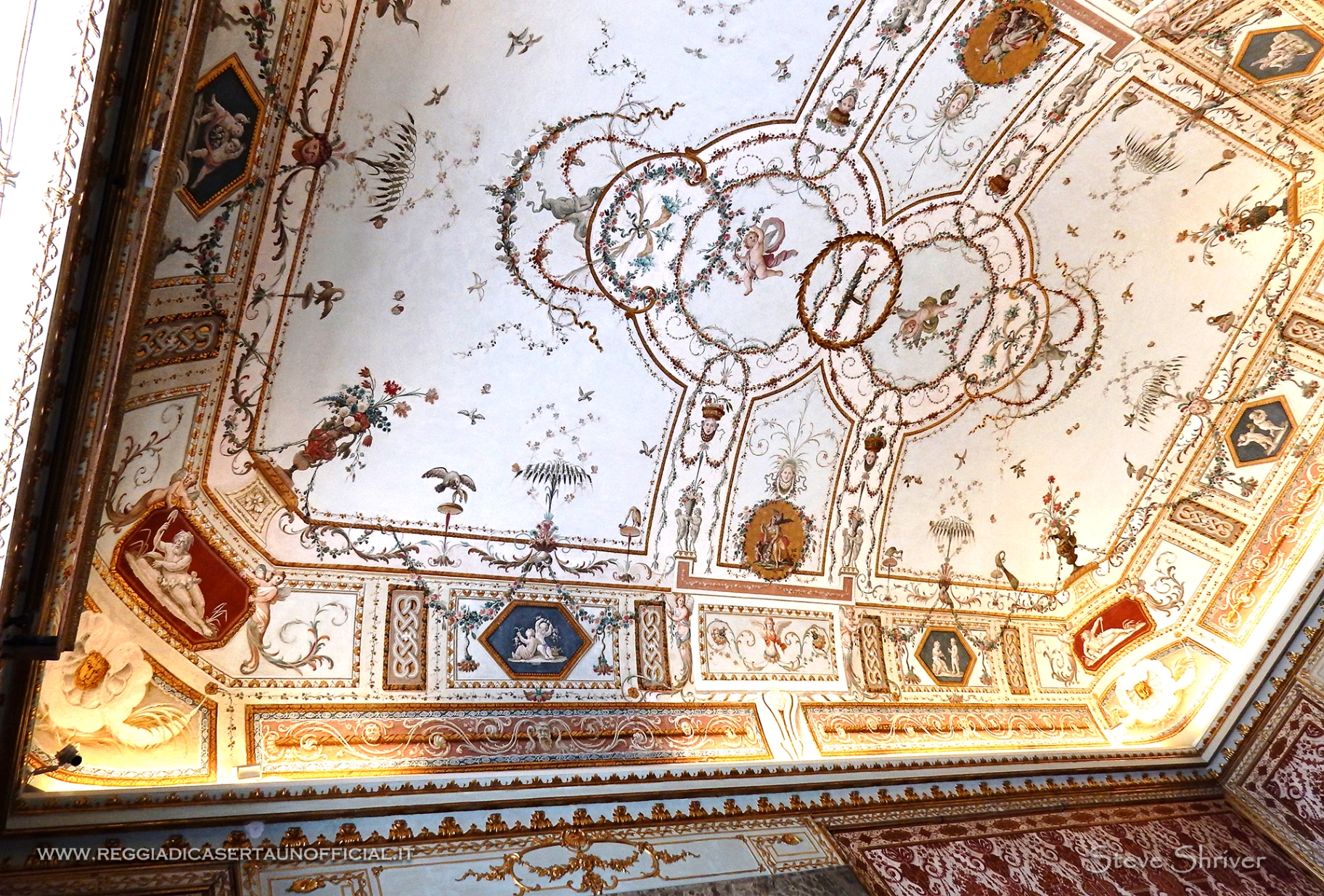
The Ceiling
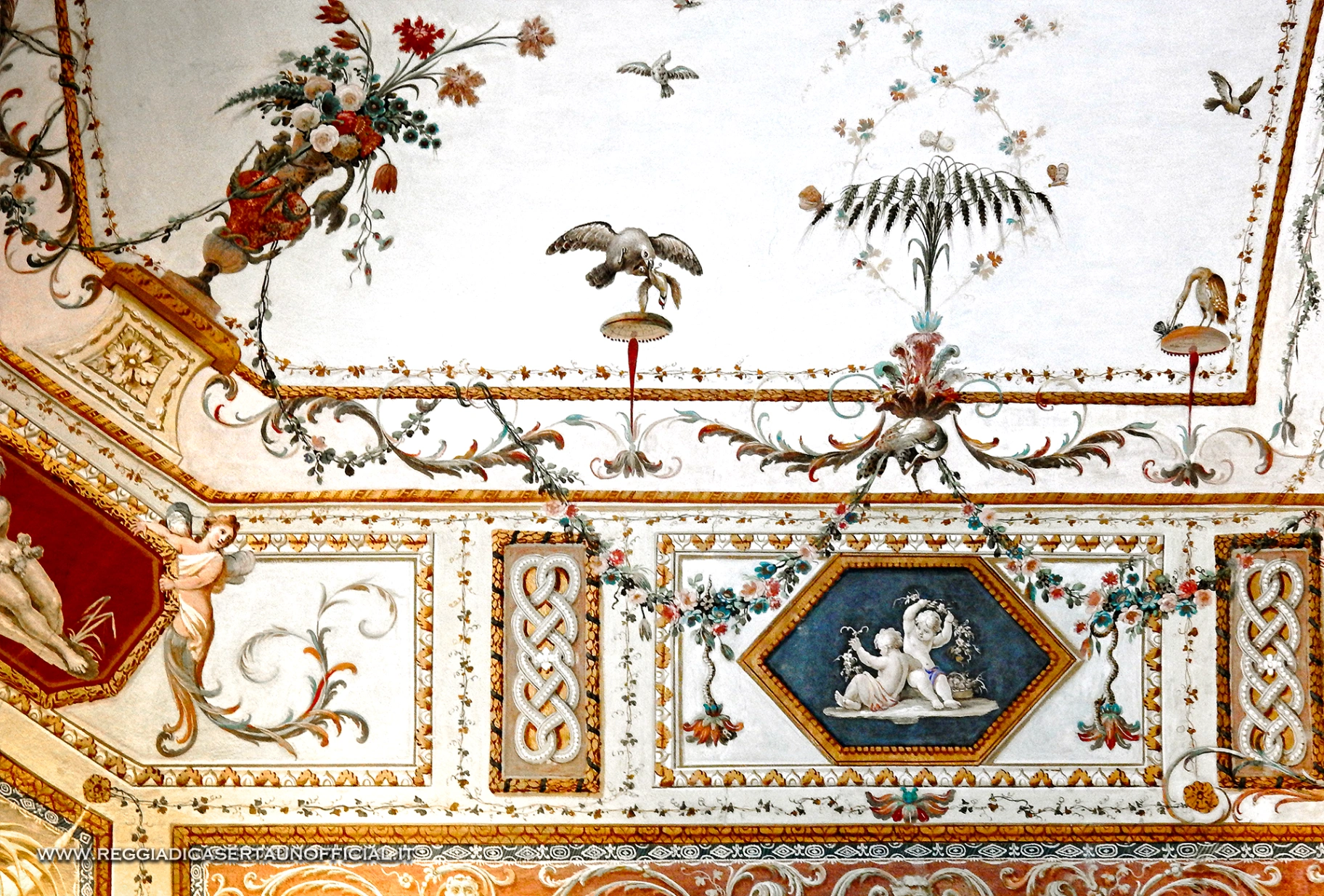
Detail
Furnishings
In this room, the walls are not covered in San Leucio silk but in high-quality French wallpaper, which is painted and embellished with gold highlights. Here, the wall coverings are made of paper rather than silk and feature sophisticated decorative motifs inspired by the archaeological repertoire of Pompeii and Herculaneum, characterized by grotesques and floral ornaments. The wall coverings are framed by finely crafted wooden moldings featuring geometric designs by Gennaro Fiore.
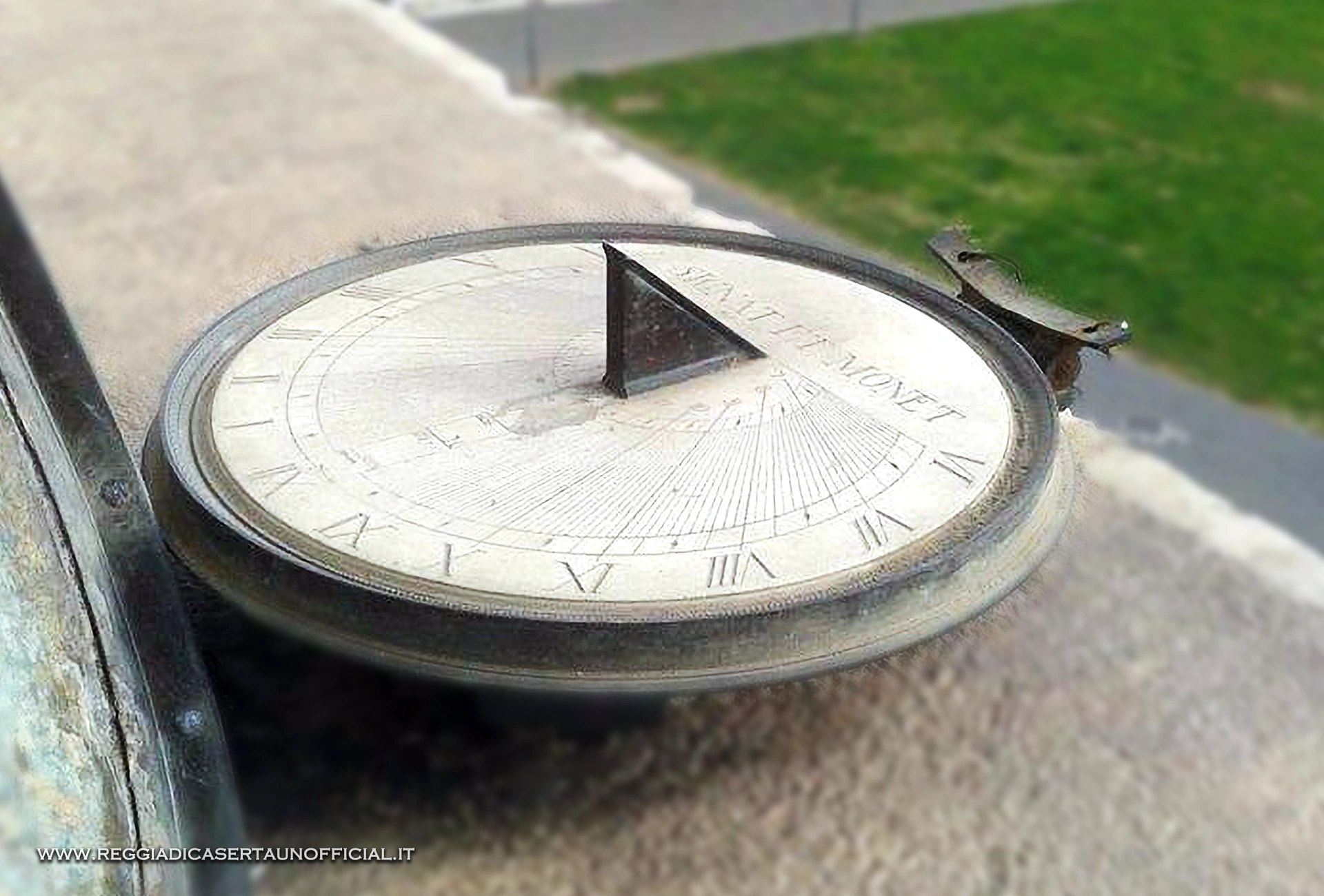
Sundial. Work by Bonaventura Bandiera – 1818
It is located on the windowsill of the antechamber. Made of white marble and bronze, it features a lid. It is one of the “rare” windowsill sundials equipped with a lid.
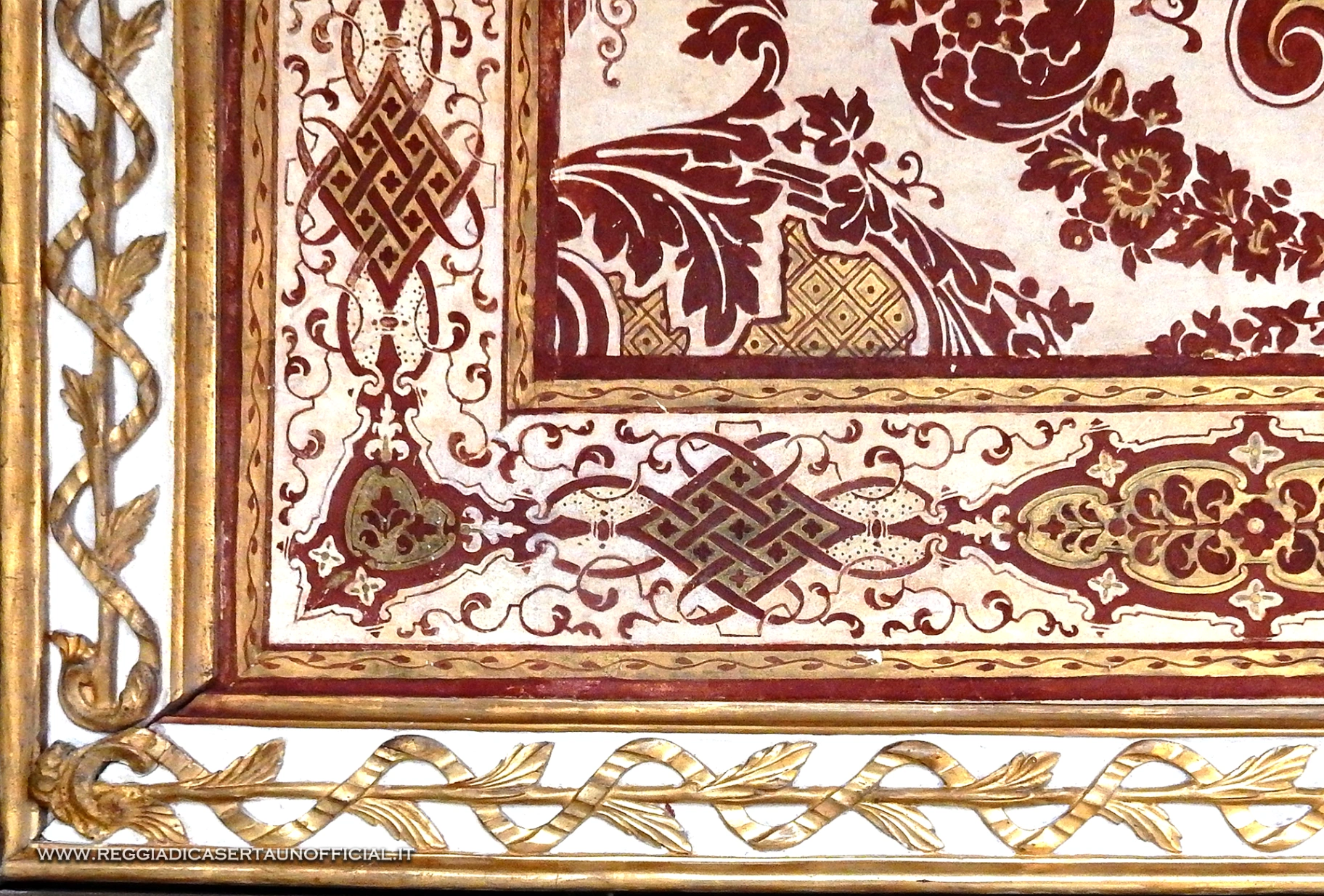
Detail of the wallpaper and wainscoting
"The Four Liberal Arts"
- Music is represented by an orchestra conductor with the features of a bear;
- Sculpture, by a poodle with tools placed on the ground and an antique statuette upon which it rests its paw;
- Architecture, by a small goat with a set square and compass;
- and finally, Painting, by a monkey at an easel with a palette and brush.
External link